



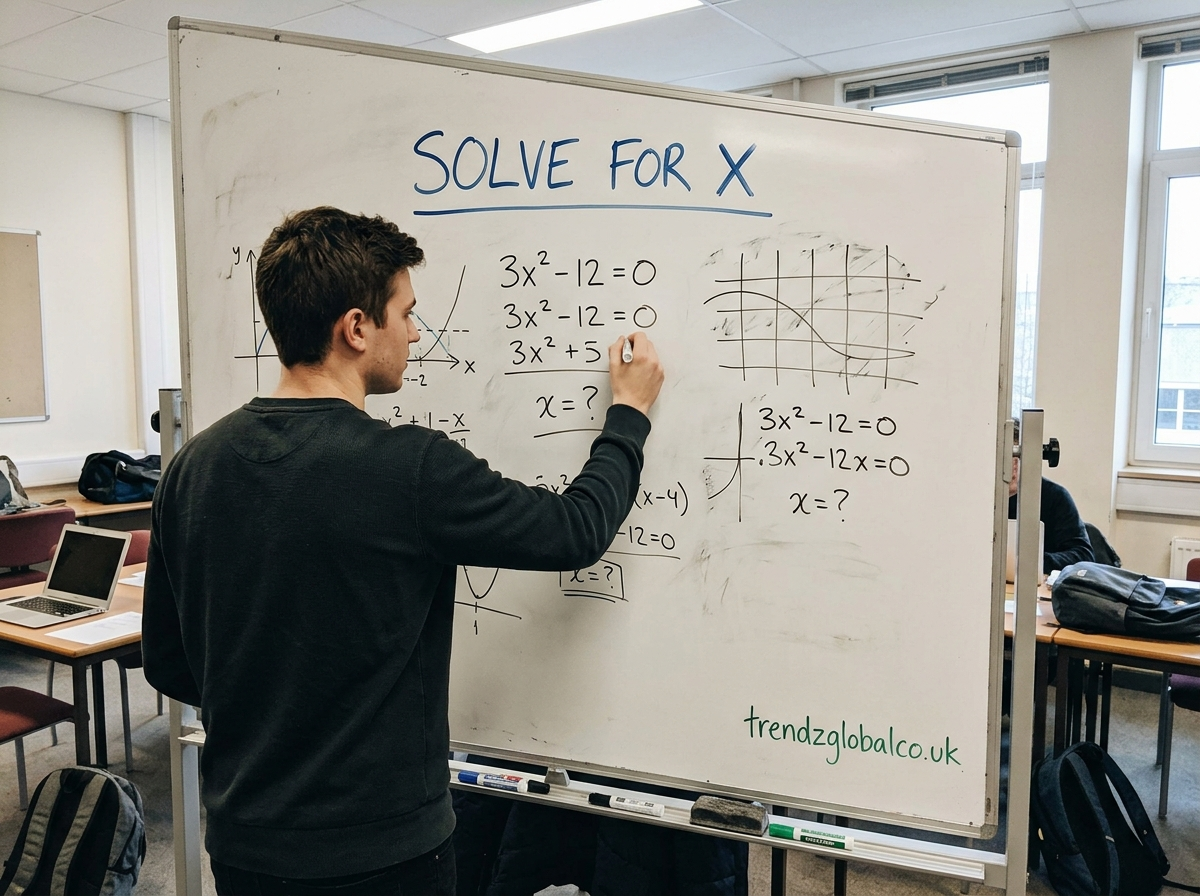
Solving for x is one of the basic skills in algebra. It means finding the unknown value of a variable in a mathematical equation. The letter x represents a number that needs to be identified by using mathematical operations.
Students often encounter solve-for-x problems in homework, classroom exercises, algebra tests, and advanced mathematics. Some equations require only one calculation, while others involve fractions, decimals, parentheses, or variables on both sides.
The easiest way to solve for x is to keep the equation balanced while using inverse operations to isolate the variable. This guide explains the basic rules, different equation types, and practical examples to help beginners understand how to find the correct value of x.
What Does Solve for X Mean?
Solve for x means finding the numerical value of x that makes an equation true. In algebra, x is called a variable because its value is not known at the beginning of the problem.
For example:
\[ x+5=12 \]
The goal is to find the number that can replace x to make both sides equal. Since 7 plus 5 equals 12, the answer is:
\[ x=7 \]
Solving for x is based on the balance of an equation. Whatever operation you perform on one side must also be performed on the other side. This keeps the equation mathematically correct.
The same idea applies to simple equations and more advanced algebra problems. The main difference is the number of steps needed to isolate the variable.
How to Solve for X Step by Step
You can solve most basic algebra equations by following a few simple steps. The goal is to move numbers away from the variable until x is alone on one side.
Consider this equation:
\[ 3x+6=21 \]
Step 1: Identify the variable and constants.
Here, x is the unknown variable, 3 is its coefficient, and 6 and 21 are constants.
Step 2: Remove the constant.
Subtract 6 from both sides:
\[ 3x+6-6=21-6 \]
\[ 3x=15 \]
Step 3: Isolate x.
Divide both sides by 3:
\[ \frac{3x}{3}=\frac{15}{3} \]
\[ x=5 \]
Step 4: Check the answer.
Replace x with 5 in the original equation:
\[ 3(5)+6=21 \]
\[ 15+6=21 \]
Both sides are equal, so the answer is correct.
Following these steps makes it easier to solve equations without skipping important calculations.
Basic Rules for Solving for X
Understanding basic algebra rules helps you solve equations accurately. These rules explain how to remove numbers from an equation while keeping both sides balanced.
Addition and subtraction: If a number is added to x, subtract that number from both sides. If a number is subtracted from x, add it to both sides.
For example:
\[ x+8=15 \]
Subtract 8 from both sides:
\[ x=15-8=7 \]
Multiplication: If x is multiplied by a number, divide both sides by that number.
\[ 5x=25 \]
\[ x=\frac{25}{5}=5 \]
Division: If x is divided by a number, multiply both sides by that number.
\[ \frac{x}{4}=6 \]
\[ x=6\times4=24 \]
Order of operations: When an equation contains multiple operations, follow the correct order when simplifying expressions. Use parentheses first, followed by exponents, multiplication and division, and addition and subtraction.
These rules form the foundation of solving algebra equations.
Solve for X Examples With Answers
Working through examples is one of the easiest ways to understand how solving for x works. Here are four common problems with step-by-step solutions.
Example 1: Solve x + 5 = 12
Subtract 5 from both sides:
\[ x+5-5=12-5 \]
\[ \boxed{x=7} \]
Example 2: Solve x – 7 = 10
Add 7 to both sides:
\[ x-7+7=10+7 \]
\[ \boxed{x=17} \]
Example 3: Solve 3x = 18
Divide both sides by 3:
\[ \frac{3x}{3}=\frac{18}{3} \]
\[ \boxed{x=6} \]
Example 4: Solve 2x + 4 = 14
First, subtract 4 from both sides:
\[ 2x=14-4 \]
\[ 2x=10 \]
Now divide both sides by 2:
\[ \boxed{x=5} \]
Each example uses the same basic principle: isolate x by reversing the operations applied to it.
How to Solve for X in Different Types of Equations
Not every equation looks the same. Some contain brackets, fractions, or decimal numbers. The method depends on the mathematical structure of the equation.
One-step equations
These equations require only one operation to find x.
For example:
\[ x+9=16 \]
Subtract 9:
\[ x=7 \]
Two-step equations
These require two operations to isolate the variable.
For example:
\[ 4x+3=19 \]
Subtract 3:
\[ 4x=16 \]
Divide by 4:
\[ x=4 \]
Equations with parentheses
First, use the distributive property to remove parentheses.
\[ 2(x+3)=14 \]
Multiply 2 by each term:
\[ 2x+6=14 \]
Subtract 6:
\[ 2x=8 \]
Divide by 2:
\[ x=4 \]
Equations with fractions
You can remove fractions by multiplying both sides by the denominator.
\[ \frac{x}{3}+2=6 \]
Subtract 2:
\[ \frac{x}{3}=4 \]
Multiply both sides by 3:
\[ x=12 \]
Equations with decimals
Treat decimal values like ordinary numbers and use basic arithmetic.
\[ 0.5x=4 \]
Divide both sides by 0.5:
\[ x=8 \]
Understanding these different equation types helps students choose the correct method for each problem.
How to Solve for X in Algebra
Algebra uses letters and symbols to represent unknown or changing values. Solving for x in algebra means simplifying an equation and finding the value that satisfies it.
One important skill is combining like terms. Like terms have the same variable raised to the same power.
For example:
\[ 3x+2x+4=19 \]
Combine the x terms:
\[ 5x+4=19 \]
Subtract 4 from both sides:
\[ 5x=15 \]
Divide by 5:
\[ x=3 \]
Some algebra equations also contain variables on both sides.
Consider:
\[ 5x+2=3x+10 \]
Subtract 3x from both sides:
\[ 2x+2=10 \]
Subtract 2:
\[ 2x=8 \]
Divide by 2:
\[ x=4 \]
The key is to collect variable terms on one side and constant numbers on the other. This makes the equation easier to solve.
How to Solve for X in Fractions and Exponents
Equations involving fractions and exponents may look difficult at first, but they follow the same basic algebra principles.
Solving equations with fractions
When an equation contains multiple fractions, multiplying by the least common denominator (LCD) can remove the denominators.
For example:
\[ \frac{x}{2}+\frac{x}{3}=5 \]
The least common denominator is 6. Multiply every term by 6:
\[ 3x+2x=30 \]
Combine like terms:
\[ 5x=30 \]
Divide by 5:
\[ x=6 \]
Solving equations with exponents
When x has an exponent, use the appropriate inverse operation.
For example:
\[ x^2=49 \]
Take the square root of both sides:
\[ x=\pm\sqrt{49} \]
\[ x=\pm7 \]
The two possible answers are x = 7 and x = -7 because both numbers produce 49 when squared.
Remember that an even exponent can produce more than one real solution, while other exponent types may require different methods.
Common Mistakes to Avoid When Solving for X
Students sometimes get incorrect answers because they misunderstand basic algebra rules or skip calculation steps. Recognizing common mistakes can make solving equations easier.
One frequent mistake is performing an operation on only one side of an equation. For example, subtracting 5 from the left side without subtracting it from the right side changes the equation’s balance.
Another common problem is handling negative numbers incorrectly. When subtracting a negative number or multiplying two negative values, pay close attention to the signs.
Students may also forget to distribute a number to every term inside parentheses. For example, 3(x + 2) equals 3x + 6, not 3x + 2.
Fractions and decimals can create additional calculation errors. Always use the correct denominator and check division carefully.
Finally, avoid skipping the verification step. Substituting your answer into the original equation helps confirm whether the result is correct.
How to Check Your Answer After Solving for X
Checking your answer is an important part of solving any algebra equation. It confirms whether the value you found makes the original equation true.
Suppose you solve:
\[ 4x+3=23 \]
After calculating, you get:
\[ x=5 \]
To check this answer, replace x with 5:
\[ 4(5)+3=23 \]
Multiply first:
\[ 20+3=23 \]
\[ 23=23 \]
Since both sides are equal, x = 5 is the correct solution.
If the two sides do not match, review your calculations. You may have made a mistake when moving a number, multiplying, dividing, or simplifying the equation.
This method works for simple linear equations, equations with fractions, and many other algebra problems.
Frequently Asked Questions About Solve for X
1. What is the easiest way to solve for x?
The easiest way is to isolate x using inverse operations. Subtract or add constants first, then divide or multiply to remove the coefficient. Always perform the same operation on both sides of the equation.
2. What are the four basic rules for solving for x?
The four basic operations are addition, subtraction, multiplication, and division. Use the inverse of an operation to isolate x. For example, subtract addition terms and divide multiplication terms.
3. How do you solve for x when there are two variables?
When an equation contains two variables, you may be able to rearrange it to express x in terms of the other variable. For example:
\[ x+y=10 \]
Subtract y from both sides:
\[ x=10-y \]
A specific numerical value for x requires additional information about y or another equation.
4. Can x have more than one solution?
Yes. Some equations have multiple solutions. For example:
\[ x^2=16 \]
Taking the square root gives:
\[ x=4 \text{ or } x=-4 \]
Both values satisfy the original equation.
5. How do you solve for x on both sides of an equation?
Collect all x terms on one side and constants on the other. For example:
\[ 4x+3=2x+11 \]
Subtract 2x from both sides:
\[ 2x+3=11 \]
Subtract 3:
\[ 2x=8 \]
Divide by 2:
\[ x=4 \]
6. What should you do first when solving an equation?
First, examine the equation and identify the variable, coefficients, and constants. Then determine which operation will help isolate x. If parentheses are present, expand them before combining like terms.
Conclusion
Solving for x is a basic algebra skill that helps students understand how equations work and how unknown values can be found. The main idea is to isolate the variable by using inverse operations while keeping both sides of the equation balanced.
Start with simple addition, subtraction, multiplication, and division problems. Then practice equations involving parentheses, fractions, decimals, and exponents. Work through each step carefully and substitute your final answer into the original equation to check it.
