



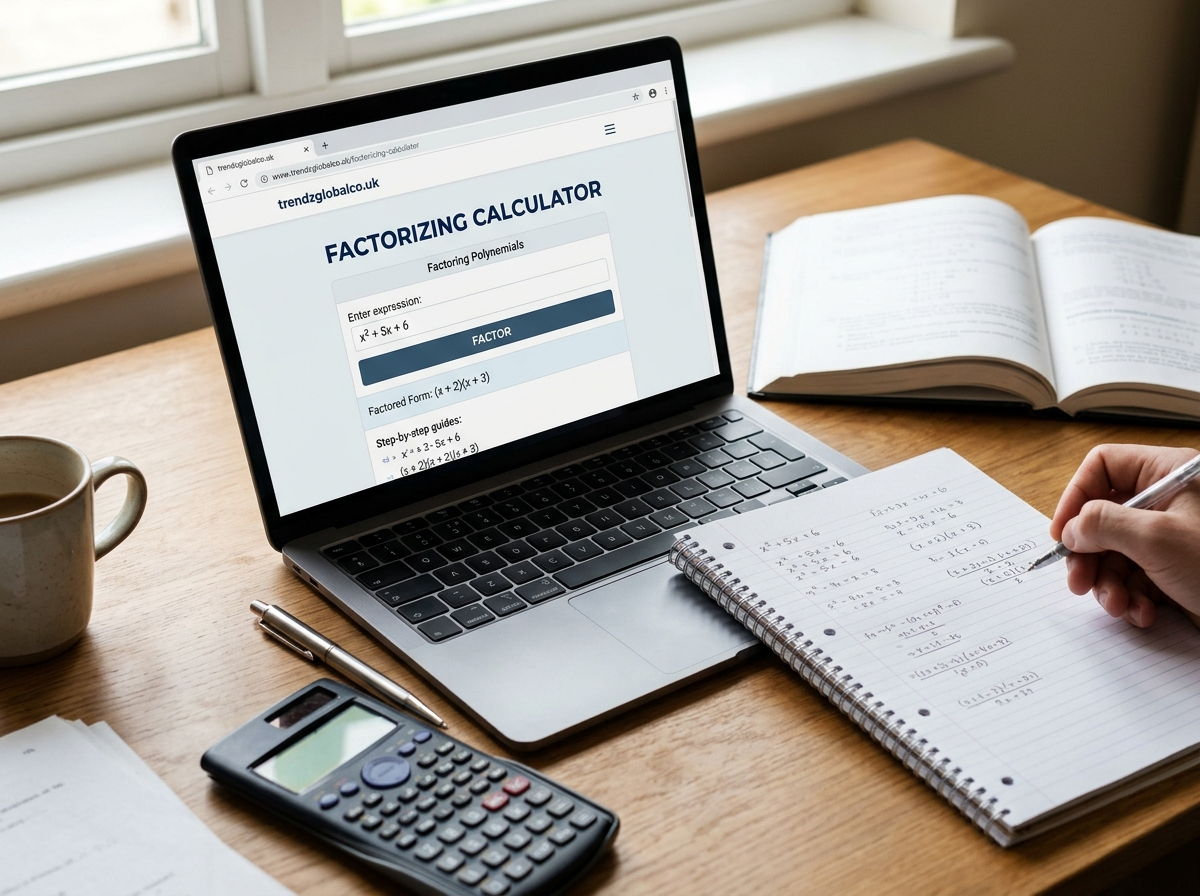
A factorizing calculator helps students and anyone working with algebra break mathematical expressions into simpler factors. Instead of spending a long time trying different factor pairs, users can enter an expression and get its factored form in seconds. It is useful for solving quadratic equations, simplifying polynomials, and checking algebra homework.
Factorization is an important part of mathematics because it makes complicated expressions easier to understand and solve. Whether you are working with simple numbers, algebraic terms, or higher-degree polynomials, a factorizing calculator can help you find the correct factors. Many calculators also provide step-by-step explanations so users can understand how an answer is reached rather than simply copying the final result.
What Is a Factorizing Calculator?
A factorizing calculator is an online mathematical tool that breaks an expression into a product of simpler expressions called factors. These factors multiply together to produce the original expression. For example, the expression \(x^2+5x+6\) can be written as \((x+2)(x+3)\).
The main purpose of a factorizing calculator is to make algebraic factorization easier. Users enter an expression, and the calculator applies suitable mathematical rules to identify its factors. Depending on the calculator, it may handle common factors, quadratic expressions, polynomial expressions, and special algebraic formulas.
Students can use this tool to check their homework, understand algebra problems, and practice different factorization methods. It is also useful for people who want to verify manual calculations or find factors without going through every calculation themselves.
How Does a Factorizing Calculator Work?
A factorizing calculator works by analyzing the mathematical expression entered by the user. It identifies the terms, coefficients, variables, and mathematical operations. After reading the expression, it applies suitable factorization rules to rewrite it in a simpler product form.
For example, consider the expression \(x^2+7x+12\). The calculator looks for two numbers whose product is 12 and whose sum is 7. These numbers are 3 and 4, so the expression becomes:
\[ x^2+7x+12=(x+3)(x+4) \]
The calculator may use different methods depending on the expression. It can identify the greatest common factor, split middle terms, recognize difference of squares, or apply quadratic factorization techniques.
Some advanced calculators also display the working process. This allows users to see which rule was applied and how the original expression was changed into its factored form. The exact features depend on the calculator being used.
How to Use a Factorizing Calculator
Using a factorizing calculator is usually simple. You do not need advanced mathematical knowledge to enter an expression and receive a result. However, entering the expression correctly is important because even a small typing mistake can change the answer.
Start by opening a factorizing calculator and locating its input field. Type the expression you want to factorize. For example, you can enter \(x^2+5x+6\). Make sure that the exponents, signs, coefficients, and variables are written correctly.
After entering the expression, select the calculate or factorize option. The tool processes the expression and displays its factored form. In this example, the result is \((x+2)(x+3)\).
If the calculator provides step-by-step solutions, review each step to understand how the factors were found. You can also multiply the final factors to check whether they produce the original expression. This simple verification helps you identify mistakes and learn the factorization process.
Types of Expressions You Can Factorize
Factorization applies to different types of mathematical expressions. A factorizing calculator may support several forms of algebraic expressions, depending on its features.
Linear expressions: These are expressions with variables raised to the first power. For example, \(3x+9\) can be factorized by taking out the common factor 3.
\[ 3x+9=3(x+3) \]
Quadratic expressions: These expressions contain a variable raised to the second power. For example:
\[ x^2+5x+6=(x+2)(x+3) \]
Polynomial expressions: A polynomial contains one or more variable terms with different powers. Factorization helps rewrite these expressions as products of simpler polynomial factors.
Expressions with common factors: When multiple terms share a number, variable, or algebraic term, the common factor can be taken outside the brackets.
\[ 4x^2+8x=4x(x+2) \]
Difference of two squares: This method applies when one perfect square is subtracted from another.
\[ x^2-16=(x-4)(x+4) \]
Perfect square trinomials: These expressions follow a special pattern and can be written as the square of a binomial.
\[ x^2+6x+9=(x+3)^2 \]
Understanding these expression types makes it easier to select the correct factorization method and interpret calculator results.
How to Factorize Algebraic Expressions Manually
Although a factorizing calculator can provide quick results, learning manual factorization is important for understanding algebra. The method depends on the structure of the expression, but the basic process involves identifying common factors and applying suitable algebraic rules.
The first step is to look for the greatest common factor (GCF). The GCF is the largest number or algebraic term that divides every term in the expression. For example, in \(6x+12\), both terms are divisible by 6.
\[ 6x+12=6(x+2) \]
For quadratic expressions, you can look for two numbers whose product equals the constant term and whose sum equals the coefficient of the middle term. Consider \(x^2+8x+15\). The numbers 3 and 5 have a product of 15 and a sum of 8.
\[ x^2+8x+15=(x+3)(x+5) \]
Another method involves recognizing special formulas. The difference of squares formula is:
\[ a^2-b^2=(a-b)(a+b) \]
For example:
\[ x^2-25=(x-5)(x+5) \]
After factorizing an expression, multiply the factors to check your result. If the expanded expression matches the original one, your factorization is correct.
Factorizing Calculator Examples With Solutions
Working through examples is one of the best ways to understand how a factorizing calculator handles different algebraic expressions. The following examples demonstrate common factorization problems and their solutions.
Example 1: Factorizing \(x^2+5x+6\)
First, identify the constant term 6 and the middle coefficient 5. Find two numbers that multiply to 6 and add up to 5. Those numbers are 2 and 3.
Therefore:
\[ x^2+5x+6=(x+2)(x+3) \]
Example 2: Factorizing \(x^2-9\)
This expression is a difference of two squares because 9 is the square of 3.
Using the difference of squares formula:
\[ x^2-9=x^2-3^2 \]
The factored result is:
\[ (x-3)(x+3) \]
Example 3: Factorizing \(2x^2+8x\)
Both terms have a common factor of \(2x\). Take it outside the brackets.
\[ 2x^2+8x=2x(x+4) \]
This is the simplest factored form.
Example 4: Factorizing \(x^2+6x+9\)
This expression is a perfect square trinomial. The numbers 3 and 3 multiply to 9 and add up to 6.
Therefore:
\[ x^2+6x+9=(x+3)(x+3) \]
Or:
\[ (x+3)^2 \]
These examples show how different factorization rules can be applied to algebraic expressions. A factorizing calculator can help users check these results and practice similar questions.
Benefits of Using a Factorizing Calculator
A factorizing calculator can make algebra practice easier by reducing the time needed to solve expressions. Students often encounter different types of factorization problems in homework, class tests, and examinations. A calculator gives them a quick way to check their work and identify the correct factored form.
One major benefit is speed. Instead of testing several possible factor pairs manually, users can enter an expression and receive a result almost immediately. This is especially useful when working with multiple polynomial expressions.
Accuracy is another advantage. Manual calculations can lead to mistakes involving negative signs, coefficients, or exponents. A reliable calculator helps users check their answers and find possible errors. However, users should still review the input and understand the mathematical steps.
Some factorizing calculators provide explanations alongside their results. These explanations help students learn how common factors are identified, how quadratic expressions are split, and how special formulas are applied.
The tool can also support independent learning. Students can solve a problem manually, compare their answer with the calculator’s result, and review any differences. This approach helps them improve their algebra skills without depending entirely on automated answers.
Factorizing Calculator vs. Manual Factorization
Both a factorizing calculator and manual factorization can help solve algebraic expressions, but they serve slightly different purposes. A calculator focuses on speed and checking results, while manual factorization helps students understand the mathematical process.
A calculator is useful when you need to factorize several expressions in a short time. You enter the expression and receive the result without testing different combinations yourself. This can save time, especially when working with longer polynomials.
Manual factorization requires users to identify patterns, find common factors, and apply algebraic rules. Although it takes more effort, it develops problem-solving skills and helps students understand why an expression can be written as a product of factors.
Accuracy also depends on how each method is used. A calculator can produce a quick answer, but incorrect input may lead to an incorrect result. Manual work can also contain errors if the rules are not applied properly.
The best approach is to use both methods together. Try solving an expression manually first, then use a factorizing calculator to verify the answer. This helps you save time while developing a better understanding of algebra.
Common Factorization Mistakes and How to Avoid Them
Factorization can become confusing when expressions contain negative signs, large coefficients, or several variable terms. Understanding common mistakes can help students produce correct answers and use a factorizing calculator more effectively.
One frequent mistake is missing the greatest common factor. For example, some students may write \(4x^2+8x\) as \(4(x^2+2x)\), which is correct but not fully factorized. Taking out the additional common factor \(x\) gives the simpler form \(4x(x+2)\).
Incorrect signs are another common problem. When factorizing quadratic expressions, the signs inside the brackets must produce the correct middle term and constant term. Always check the product and sum of the selected numbers.
Students may also apply the wrong formula. For example, the difference of squares formula works for \(x^2-16\), but it does not apply directly to \(x^2+16\) over the real numbers in the same way.
Another mistake is stopping before reaching the simplest factored form. An expression may be written as a product but still contain factors that can be broken down further.
To avoid these errors, check every factorization by expanding the brackets. If the result matches the original expression, the answer is correct. A calculator can support this checking process, but understanding the rules remains essential.
Frequently Asked Questions About Factorizing Calculator
1. What is a factorizing calculator used for?
A factorizing calculator is used to break algebraic expressions into simpler factors. It can help users solve quadratic expressions, identify common factors, and factorize different types of polynomials. Students often use it to check homework and understand algebra problems.
2. Can a factorizing calculator solve quadratic expressions?
Yes, many factorizing calculators can solve quadratic expressions. For example, an expression such as \(x^2+7x+12\) can be factorized into \((x+3)(x+4)\). Some calculators also provide the steps used to reach the result.
3. Can I factorize polynomials using a calculator?
Yes, if the calculator supports polynomial factorization. You can enter a polynomial expression, and the tool will attempt to rewrite it as a product of simpler polynomial factors. The supported degree and types of coefficients depend on the calculator.
4. Does a factorizing calculator show step-by-step solutions?
Some factorizing calculators provide step-by-step solutions, while others display only the final answer. A step-by-step feature is useful for students because it explains how common factors, factor pairs, and algebraic formulas are used.
5. How do I factorize an expression manually?
Start by finding the greatest common factor shared by all terms. If the expression is quadratic, look for two numbers whose product equals the constant term and whose sum equals the middle coefficient. Apply the appropriate factorization rule and multiply the factors to verify your answer.
6. Is a factorizing calculator useful for students?
Yes, it is useful for students learning algebra and practicing factorization. It helps them check answers, understand different mathematical patterns, and save time on calculations. Students should also practice solving expressions manually to build their mathematical skills.
7. Can a factorizing calculator find the greatest common factor?
Many factorizing calculators can identify common factors and use them to simplify expressions. For example, the expression \(12x+18\) has a greatest common factor of 6, so its factored form is \(6(2x+3)\). However, the exact GCF features depend on the calculator.
Conclusion
A factorizing calculator provides a simple way to break algebraic expressions into smaller factors. It can help with linear expressions, quadratic equations, polynomials, common factors, and special algebraic formulas. Users can enter an expression, view its factored form, and check their mathematical work.
For students, the tool is most useful when combined with manual practice. Learning how to identify the greatest common factor, recognize quadratic patterns, and apply factorization formulas makes it easier to understand algebra. By using a factorizing calculator to verify answers and review solution steps, learners can improve their confidence and solve mathematical problems more effectively.
