



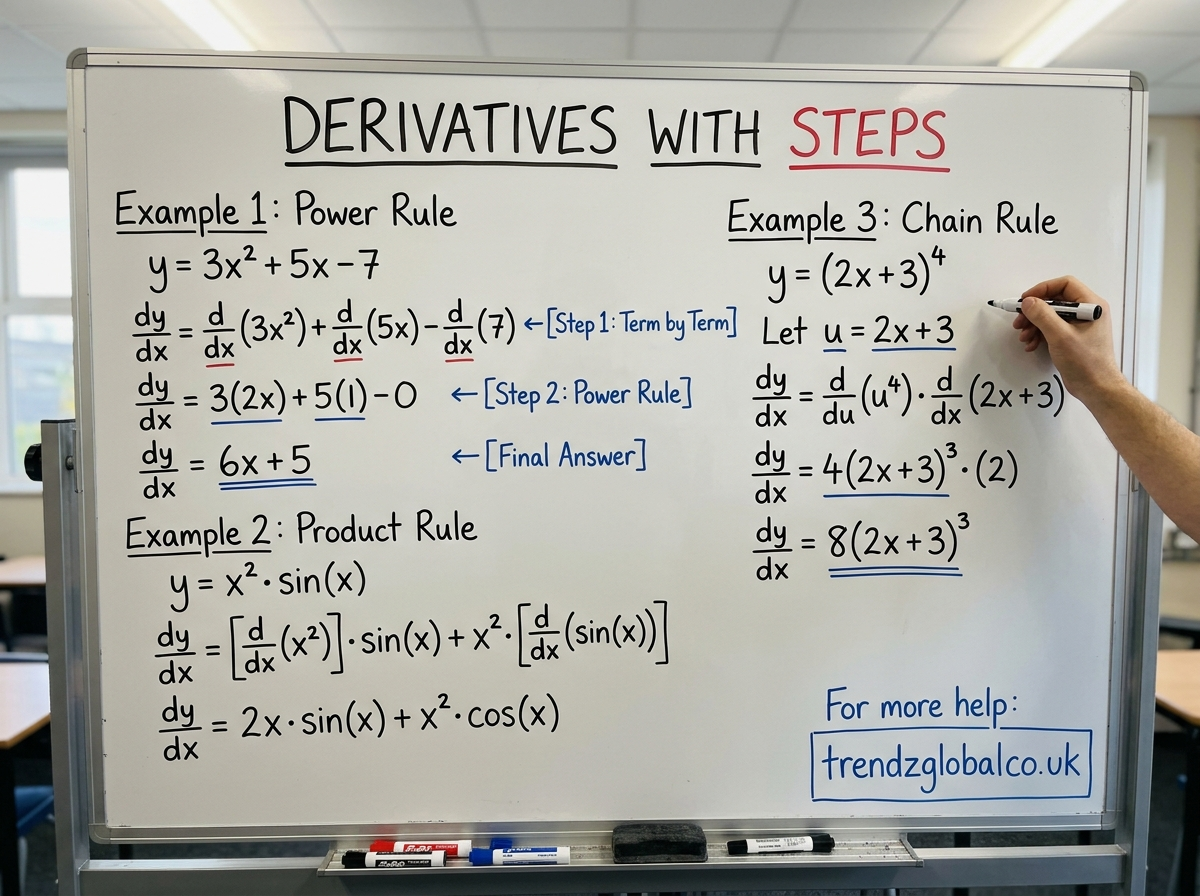
Derivatives are an important part of calculus. They help students understand how a function changes when its input value changes. Whether you are solving polynomial equations, working with trigonometric functions, or studying advanced calculus, learning how to find derivatives is an essential mathematical skill.
If you are searching for derivatives with steps, you may want more than just the final answer. You need to understand which differentiation rule applies, how to use the formula, and how each calculation leads to the result.
Finding a derivative becomes easier when you follow a clear process. You first identify the function, select the correct differentiation rule, apply it, and simplify the result. This guide explains the main rules of differentiation with practical examples so you can understand how to solve different derivative problems.
What Are Derivatives in Calculus?
A derivative measures how quickly a function changes with respect to its input variable. In simple terms, it tells you the rate of change of one quantity compared with another. For example, if a function represents the position of a moving object over time, its derivative represents the object’s velocity.
Derivatives also describe the slope of a curve at a particular point. A straight line has the same slope at every point, but a curved graph can have different slopes depending on where you measure it. The derivative helps calculate the exact slope of a curve at a selected point.
The derivative of a function \(f(x)\) is commonly written as \(f'(x)\) or \(\frac{dy}{dx}\). Both notations represent differentiation with respect to \(x\). For example, if \(f(x)=x^2\), its derivative is \(f'(x)=2x\). This means the rate of change depends on the value of \(x\).
The general definition of a derivative uses a limit:
\[ f'(x)=\lim_{h\to 0}\frac{f(x+h)-f(x)}{h} \]
This formula explains the mathematical foundation of differentiation. However, students usually use differentiation rules to solve everyday calculus problems more quickly.
How to Find Derivatives Step by Step
Finding derivatives follows a simple process. The method depends on the type of function, but the main idea remains the same. Start by identifying the expression and then choose a suitable rule.
Consider the function:
\[ f(x)=3x^4+5x^2-7x+9 \]
Step 1: Identify the function.
The given expression contains three terms with variables and one constant term.
Step 2: Apply the power rule.
The power rule states:
\[ \frac{d}{dx}(x^n)=nx^{n-1} \]
Apply it to each term:
\[ 3x^4\rightarrow 12x^3 \]
\[ 5x^2\rightarrow 10x \]
\[ -7x\rightarrow -7 \]
The derivative of the constant \(9\) is zero.
Step 3: Combine the results.
\[ f'(x)=12x^3+10x-7 \]
Step 4: Check the final answer.
Each variable term has been differentiated, and the constant has disappeared. The final derivative is:
\[ \boxed{f'(x)=12x^3+10x-7} \]
Following these steps helps prevent calculation errors and makes longer derivative problems easier to understand.
Basic Rules of Differentiation
Differentiation rules provide shortcuts for finding derivatives without using the limit definition every time. Learning these rules helps students solve different types of functions.
Power Rule
The power rule is used when a variable has an exponent.
\[ \frac{d}{dx}(x^n)=nx^{n-1} \]
For example:
\[ f(x)=x^5 \]
Multiply the exponent by the coefficient and subtract one from the exponent:
\[ f'(x)=5x^4 \]
Constant Rule
The derivative of any constant number is zero because a constant does not change.
\[ \frac{d}{dx}(c)=0 \]
For example:
\[ f(x)=15 \]
\[ f'(x)=0 \]
Constant Multiple Rule
When a function is multiplied by a constant, keep the constant and differentiate the function.
\[ \frac{d}{dx}[cf(x)]=cf'(x) \]
For example:
\[ f(x)=6x^3 \]
\[ f'(x)=6(3x^2)=18x^2 \]
Sum and Difference Rules
The derivative of a sum or difference is the sum or difference of the individual derivatives.
\[ \frac{d}{dx}[f(x)\pm g(x)] =f'(x)\pm g'(x) \]
For example:
\[ f(x)=x^3+4x^2 \]
\[ f'(x)=3x^2+8x \]
Product Rule
Use the product rule when two functions are multiplied together.
\[ (uv)’=u’v+uv’ \]
For example:
\[ f(x)=x^2\sin x \]
Let \(u=x^2\) and \(v=\sin x\).
\[ u’=2x,\quad v’=\cos x \]
Therefore:
\[ f'(x)=2x\sin x+x^2\cos x \]
Quotient Rule
The quotient rule applies when one function is divided by another.
\[ \left(\frac{u}{v}\right)’ =\frac{vu’-uv’}{v^2} \]
For example:
\[ f(x)=\frac{x^2+1}{x} \]
Let \(u=x^2+1\) and \(v=x\).
\[ u’=2x,\quad v’=1 \]
Substitute into the formula:
\[ f'(x)=\frac{x(2x)-(x^2+1)(1)}{x^2} \]
Simplify:
\[ f'(x)=\frac{x^2-1}{x^2} \]
Chain Rule
The chain rule is used when one function is inside another function.
\[ \frac{d}{dx}f(g(x))=f'(g(x))g'(x) \]
For example:
\[ f(x)=(3x+2)^4 \]
Differentiate the outer function first:
\[ 4(3x+2)^3 \]
Then multiply by the derivative of the inner function, which is 3.
\[ f'(x)=12(3x+2)^3 \]
Derivatives with Steps: Solved Examples
Worked examples make differentiation easier to understand because they show how mathematical rules apply to actual problems. Here are several common examples.
Example 1: Derivative of a Simple Polynomial
Find the derivative of:
\[ f(x)=5x^3 \]
Apply the power rule:
\[ f'(x)=5(3)x^{3-1} \]
Simplify:
\[ \boxed{f'(x)=15x^2} \]
Example 2: Derivative of a Constant
Find the derivative of:
\[ f(x)=25 \]
The derivative of a constant is always zero.
\[ \boxed{f'(x)=0} \]
Example 3: Derivative of a Linear Function
Given:
\[ f(x)=7x+4 \]
Differentiate each term:
\[ f'(x)=7+0 \]
Final answer:
\[ \boxed{f'(x)=7} \]
Example 4: Derivative of a Quadratic Function
Find the derivative of:
\[ f(x)=4x^2+6x-8 \]
Apply the power rule to the first two terms and the constant rule to the last term:
\[ f'(x)=8x+6-0 \]
Therefore:
\[ \boxed{f'(x)=8x+6} \]
Example 5: Derivative of a Fraction
Find the derivative of:
\[ f(x)=\frac{1}{x^2} \]
First, rewrite the fraction using a negative exponent:
\[ f(x)=x^{-2} \]
Apply the power rule:
\[ f'(x)=-2x^{-3} \]
Rewrite it as a fraction:
\[ \boxed{f'(x)=-\frac{2}{x^3}} \]
Example 6: Derivative of a Function with Powers
Find the derivative of:
\[ f(x)=2x^5-3x^3+4x^2-6 \]
Differentiate each term:
\[ f'(x)=10x^4-9x^2+8x-0 \]
Final answer:
\[ \boxed{f'(x)=10x^4-9x^2+8x} \]
These examples cover several common derivative problems. Practicing similar expressions helps students recognize which rule to apply.
How to Solve Derivatives Using the Power Rule
The power rule is one of the most frequently used methods in calculus. It makes differentiating polynomial expressions easier because you do not need to calculate limits for every term.
The formula is:
\[ \frac{d}{dx}(ax^n)=anx^{n-1} \]
Here, \(a\) represents the coefficient, while \(n\) represents the exponent of the variable. To use this rule, multiply the coefficient by the exponent and reduce the exponent by one.
Consider this example:
\[ f(x)=8x^6 \]
First, identify the coefficient and exponent. The coefficient is 8, and the exponent is 6.
Multiply them:
\[ 8\times6=48 \]
Subtract one from the exponent:
\[ 6-1=5 \]
Write the final derivative:
\[ \boxed{f'(x)=48x^5} \]
The power rule also works with negative and fractional exponents. For example:
\[ f(x)=x^{-3} \]
\[ f'(x)=-3x^{-4} \]
Similarly, consider:
\[ f(x)=\sqrt{x}=x^{1/2} \]
Applying the power rule gives:
\[ f'(x)=\frac12x^{-1/2} \]
Or:
\[ \boxed{f'(x)=\frac{1}{2\sqrt{x}}} \]
One common mistake is forgetting to subtract one from the original exponent. Another is multiplying the coefficient incorrectly. Checking these two steps can help improve accuracy.
How to Find Derivatives of Trigonometric Functions
Trigonometric derivatives are used in calculus problems involving angles, waves, periodic motion, and changing signals. Each trigonometric function has its own differentiation formula.
The most common formulas are:
\[ \frac{d}{dx}(\sin x)=\cos x \]
\[ \frac{d}{dx}(\cos x)=-\sin x \]
\[ \frac{d}{dx}(\tan x)=\sec^2 x \]
Other useful formulas include:
\[ \frac{d}{dx}(\cot x)=-\csc^2 x \]
\[ \frac{d}{dx}(\sec x)=\sec x\tan x \]
\[ \frac{d}{dx}(\csc x)=-\csc x\cot x \]
Example 1: Derivative of sin(x)
Given:
\[ f(x)=5\sin x \]
Keep the constant and differentiate the trigonometric function:
\[ f'(x)=5\cos x \]
Example 2: Derivative of cos(x)
Given:
\[ f(x)=3\cos x \]
Use the cosine derivative rule:
\[ f'(x)=-3\sin x \]
Example 3: Derivative of tan(x)
Given:
\[ f(x)=4\tan x \]
Apply the tangent derivative formula:
\[ \boxed{f'(x)=4\sec^2 x} \]
For functions with expressions inside the trigonometric function, you may also need the chain rule. For example:
\[ f(x)=\sin(2x) \]
Differentiate the outer function and multiply by the derivative of the inner expression:
\[ \boxed{f'(x)=2\cos(2x)} \]
How to Differentiate Using the Product, Quotient, and Chain Rules
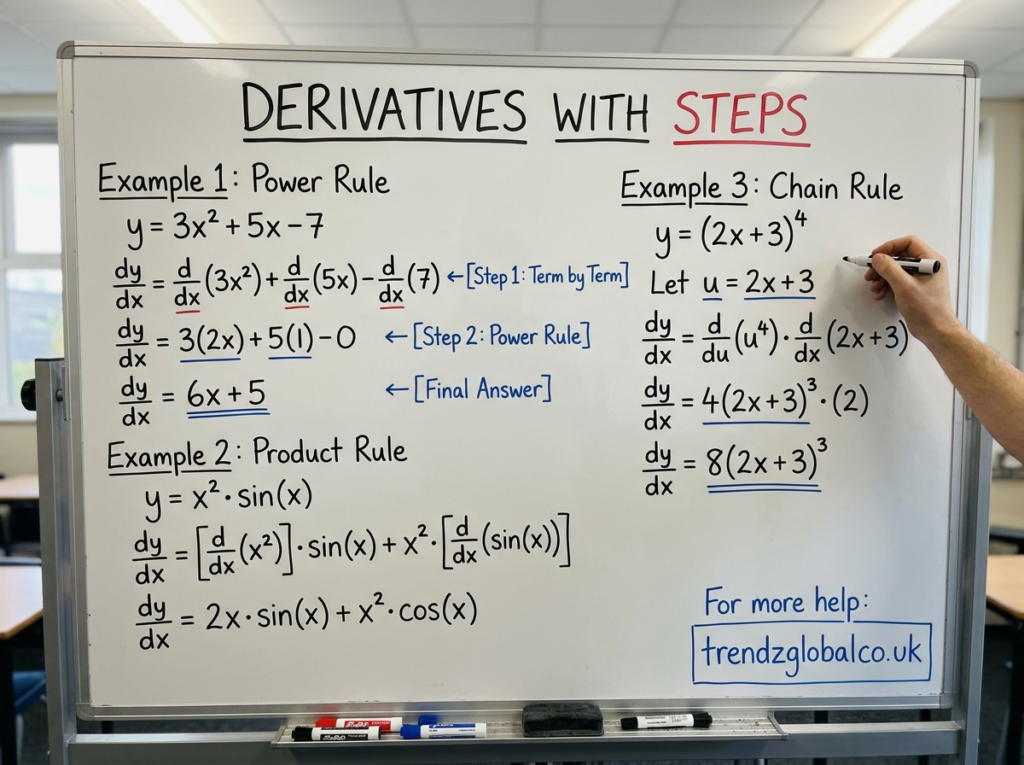
Some derivative problems contain multiple functions combined through multiplication, division, or composition. In these situations, the power rule alone may not be enough. The product, quotient, and chain rules help solve these expressions correctly.
Product Rule Example
Find the derivative of:
\[ f(x)=(x^2+1)(x^3+2) \]
Let:
\[ u=x^2+1,\quad v=x^3+2 \]
Differentiate both functions:
\[ u’=2x,\quad v’=3x^2 \]
Apply the product rule:
\[ f'(x)=u’v+uv’ \]
Substitute the values:
\[ f'(x)=2x(x^3+2)+(x^2+1)(3x^2) \]
Expand and simplify:
\[ f'(x)=2x^4+4x+3x^4+3x^2 \]
Final answer:
\[ \boxed{f'(x)=5x^4+3x^2+4x} \]
Quotient Rule Example
Find the derivative of:
\[ f(x)=\frac{x+2}{x^2} \]
Let:
\[ u=x+2,\quad v=x^2 \]
Then:
\[ u’=1,\quad v’=2x \]
Apply the quotient rule:
\[ f'(x)=\frac{x^2(1)-(x+2)(2x)}{x^4} \]
Expand:
\[ f'(x)=\frac{x^2-2x^2-4x}{x^4} \]
Simplify:
\[ \boxed{f'(x)=-\frac{x+4}{x^3}} \]
Chain Rule Example
Find the derivative of:
\[ f(x)=(2x^2+3)^5 \]
Differentiate the outer expression:
\[ 5(2x^2+3)^4 \]
Now differentiate the inner expression:
\[ \frac{d}{dx}(2x^2+3)=4x \]
Multiply both results:
\[ f'(x)=5(2x^2+3)^4(4x) \]
Final answer:
\[ \boxed{f'(x)=20x(2x^2+3)^4} \]
Understanding the differences between these three rules makes it easier to solve more advanced differentiation problems.
How a Derivatives Calculator with Steps Works
A derivatives calculator with steps helps students find the derivative of a mathematical function and understand the calculations behind the result. Instead of manually applying every formula, users can enter an expression and view its derivative.
Most derivative calculators follow a straightforward process. The user enters a function, selects the variable for differentiation if necessary, and submits the expression. The calculator processes the function using differentiation rules and displays the resulting derivative.
For example, if you enter:
\[ f(x)=x^3+4x^2+2x \]
The calculator may show the following steps:
First, identify the individual terms:
\[ x^3,\quad 4x^2,\quad 2x \]
Apply the power rule:
\[ 3x^2,\quad 8x,\quad 2 \]
Combine the derivatives:
\[ \boxed{f'(x)=3x^2+8x+2} \]
A step-by-step calculator is useful for checking homework, reviewing differentiation formulas, and understanding where a calculation went wrong. Students can compare calculator results with their handwritten solutions to find mistakes.
However, a calculator should support learning rather than replace it. Understanding why a particular rule applies is necessary when solving examination questions or more complicated calculus problems.
Common Mistakes to Avoid When Finding Derivatives
Students sometimes get incorrect answers because they misunderstand differentiation rules or skip important calculation steps. Recognizing common mistakes can help make derivative solutions more accurate.
One frequent mistake is applying the power rule incorrectly. Remember that you must multiply the coefficient by the exponent and then reduce the exponent by one. For example, the derivative of \(x^4\) is \(4x^3\), not \(4x^4\).
Another common error is forgetting that the derivative of a constant is zero. If a function contains a constant such as 8 or 15, that term disappears after differentiation. For example, the derivative of \(x^2+8\) is \(2x\), not \(2x+8\).
Some students also confuse the product rule with the quotient rule. These formulas are different and must be used according to the structure of the given expression. The product rule applies to multiplication, while the quotient rule applies to division.
Forgetting the chain rule is another problem, especially when a function contains brackets with powers. For example, differentiating \((3x+1)^2\) requires multiplying the derivative of the outer function by the derivative of the inner function.
Finally, avoid skipping simplification and checking your work. A derivative may be mathematically correct but written in a complicated form. Simplifying the expression makes the final answer easier to read and verify.
Frequently Asked Questions About Derivatives with Steps
1. How do you find derivatives step by step?
Start by identifying the given function and the variable you need to differentiate. Choose the appropriate differentiation rule, apply it to each term, and simplify the expression. Check the final result to make sure you have used the correct formula.
2. What is the easiest way to calculate a derivative?
The power rule is usually the easiest method for polynomial functions. Multiply the coefficient by the exponent and subtract one from the exponent. For example, the derivative of \(x^5\) is \(5x^4\). Other functions may require the product, quotient, or chain rule.
3. What are the five basic rules of differentiation?
Five commonly taught differentiation rules are the power rule, constant rule, constant multiple rule, sum and difference rules, and product rule. The quotient rule and chain rule are also essential for solving more complex functions.
4. How do you find the derivative of x²?
Apply the power rule:
\[ \frac{d}{dx}(x^2)=2x^{2-1} \]
Simplify:
\[ \boxed{2x} \]
Therefore, the derivative of \(x^2\) is \(2x\).
5. Can I calculate derivatives without a calculator?
Yes. You can calculate derivatives manually by learning differentiation rules and practicing worked examples. A calculator is helpful for checking answers, but understanding the formulas allows you to solve problems independently.
6. How does a derivative calculator show steps?
A derivative calculator takes the entered function, identifies its mathematical structure, and applies suitable differentiation rules. It then displays the derivative and, depending on the calculator, explains the calculations used to reach the answer.
7. What is the difference between differentiation and derivatives?
Differentiation is the mathematical process of finding the derivative of a function. A derivative is the result of that process. For example, finding the derivative of \(x^3\) is differentiation, while \(3x^2\) is the resulting derivative.
Conclusion
Learning derivatives with steps makes calculus easier because it helps students understand how mathematical expressions change and how differentiation formulas work. Starting with the power rule, constant rule, and sum rule provides a strong foundation for solving basic functions. Product, quotient, and chain rules help with more complicated expressions.
Worked examples are useful for understanding each calculation, while regular practice helps students recognize the correct rule for different problems. A derivatives calculator with steps can also help check answers and explain calculations, but students should learn the underlying methods instead of relying only on final results.
