



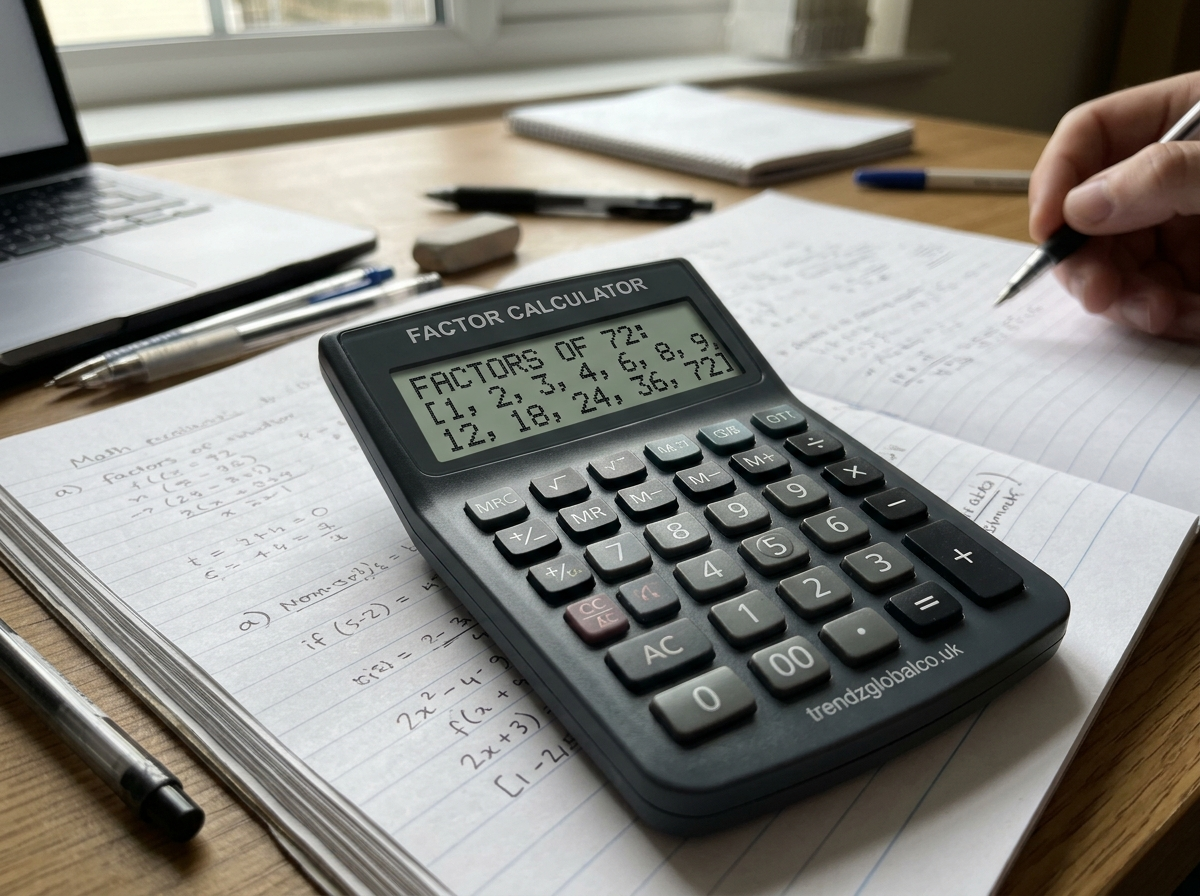
A factor calcualtor helps you find all the factors of a number without checking every possible division manually. Whether you are solving homework questions, studying number theory, or checking a mathematical answer, this tool makes factor calculations easier. Enter a number, and the calculator can identify the numbers that divide it evenly, along with factor pairs and other useful results.
Understanding factors is an important part of mathematics. Factors help students work with multiplication, division, prime numbers, fractions, and algebra. A factor calcualtor is useful when you need quick results, but learning how those results are calculated also helps you understand the subject.
What Is a Factor Calculator?
A factor calculator is a mathematical tool that identifies all the numbers that divide a given number without leaving a remainder. These numbers are called factors or divisors. For example, the factors of 12 are 1, 2, 3, 4, 6, and 12 because each of these numbers divides 12 evenly.
The calculator checks which numbers can divide the entered value and produces a list of valid factors. Some calculators also display factor pairs, prime factors, and prime factorization. These results help users understand how a number can be represented through multiplication.
Students often use this tool to check their homework and practice division problems. Teachers can use it when preparing examples, while parents can use it to help children understand basic mathematics. It is also useful for anyone who needs to check factors without doing repeated calculations by hand.
How Does a Factor Calculator Work?
A factor calcualtor works by testing whether different numbers divide the entered number evenly. It uses the division rule to identify valid factors. If dividing one number by another produces a whole number with no remainder, the divisor is considered a factor.
For example, suppose you enter 18. The calculator checks possible divisors and identifies 1, 2, 3, 6, 9, and 18. Each number divides 18 without producing a remainder. Numbers such as 4, 5, and 7 are not included because they do not divide 18 evenly.
Many calculators use an efficient method based on the square root of the input number. Instead of testing every number up to the original value, the calculator checks divisors up to the square root and identifies their matching factor pairs. This reduces unnecessary calculations, especially when working with larger numbers.
How to Use a Factor Calculator
Using a factor calcualtor is simple. You only need the number whose factors you want to find. Most online tools provide a single input field where you can enter a whole number and generate the result.
Start by opening the calculator and typing your number into the input box. Check that you have entered the correct value, then select the calculate or solve option. The tool will process the number and display its factors. Depending on its features, it may also show factor pairs, prime factors, or a step-by-step explanation.
After receiving the result, review the list to understand how each factor works. You can verify any factor by dividing the original number by it. If the result is a whole number, the factor is correct. For example, when calculating the factors of 30, dividing 30 by 5 gives 6, so both 5 and 6 are factors of 30.
How to Find All Factors of a Number
You can find factors manually by checking which whole numbers divide the given number without a remainder. Start with 1 because it is a factor of every positive whole number. Then test 2, 3, 4, and other possible divisors until you have identified every factor.
Consider the number 24. Dividing 24 by 1 gives 24, so 1 and 24 form a factor pair. Dividing 24 by 2 gives 12, creating another pair. The next pairs are 3 and 8, followed by 4 and 6. These pairs provide the complete positive factor list.
The factors of 24 are:
1, 2, 3, 4, 6, 8, 12, 24.
You do not need to continue checking numbers after reaching the square root of 24 because the remaining factors have already appeared as partners in the earlier pairs. This method works for other positive whole numbers and helps you understand the process used by a factor calculator.
What Are Factor Pairs?
Factor pairs are two numbers that multiply together to produce a particular number. Every factor in a pair divides the original number evenly. For example, the factor pairs of 24 are (1, 24), (2, 12), (3, 8), and (4, 6).
Factor pairs make multiplication and division easier to understand. Instead of looking at a long list of factors, you can see how two numbers work together to create the original value. They also help students check whether they have found all the factors of a number.
For example, the number 36 has these positive factor pairs:
- 1 × 36 = 36
- 2 × 18 = 36
- 3 × 12 = 36
- 4 × 9 = 36
- 6 × 6 = 36
A factor calculator may display these pairs alongside the complete factor list. This makes it easier to identify relationships between numbers and understand multiplication facts.
What Is Prime Factorization?
Prime factorization is the process of expressing a number as a product of prime numbers. A prime number has exactly two positive factors: 1 and itself. Examples include 2, 3, 5, 7, 11, and 13.
For example, consider the number 36. It can be divided by 2 to get 18. Dividing 18 by 2 gives 9, and dividing 9 by 3 gives 3. The final result contains only prime numbers.
Therefore:
36 = 2 × 2 × 3 × 3
This is the prime factorization of 36. It can also be written as:
36 = 2² × 3²
Prime factorization is different from finding all factors. The complete factor list contains every number that divides the original number evenly, while prime factorization shows the prime numbers that multiply together to create it.
A factor calcualtor with prime factorization features can provide this result automatically. It is particularly helpful when working with larger numbers or checking calculations involving fractions, greatest common factors, and least common multiples.
Types of Factors You Can Calculate
There are different types of factors in mathematics. Each type describes a particular relationship between numbers. Knowing these differences helps you understand the results produced by a factor calculator.
Positive factors are whole numbers greater than zero that divide the original number evenly. For example, the positive factors of 10 are 1, 2, 5, and 10.
Negative factors are negative numbers that also divide the original number without leaving a remainder. The negative factors of 10 are -1, -2, -5, and -10. Positive and negative factors can be used when working with integers.
Prime factors are factors that are prime numbers. For example, the prime factors of 30 are 2, 3, and 5.
Composite factors are positive factors greater than 1 that are not prime. For example, 4, 6, and 12 are composite factors of 24.
Common factors are numbers that divide two or more given numbers evenly. For example, the common factors of 12 and 18 are 1, 2, 3, and 6. These factors are useful when finding the greatest common factor.
Not every online calculator provides all these options. Some tools only display positive factors, while others include prime factorization and additional results.
Factor Calculator Examples
Working through examples is one of the easiest ways to understand how factor calculations work. The following examples show the positive factors of different numbers and how they form multiplication pairs.
Factors of 12
The positive factors of 12 are 1, 2, 3, 4, 6, and 12. Its factor pairs are (1, 12), (2, 6), and (3, 4). Each pair multiplies to produce 12.
Factors of 24
The positive factors of 24 are 1, 2, 3, 4, 6, 8, 12, and 24. Its factor pairs are (1, 24), (2, 12), (3, 8), and (4, 6).
Factors of 36
The positive factors of 36 are 1, 2, 3, 4, 6, 9, 12, 18, and 36. Its factor pairs are (1, 36), (2, 18), (3, 12), (4, 9), and (6, 6).
Factors of 48
The positive factors of 48 are 1, 2, 3, 4, 6, 8, 12, 16, 24, and 48. Its factor pairs are (1, 48), (2, 24), (3, 16), (4, 12), and (6, 8).
These examples show that different numbers have different quantities of factors. A calculator can generate these lists quickly, while factor pairs help you verify that the results are correct.
Factor Calculator vs. Manual Factorization
A factor calculator and manual factorization both help you find the factors of a number, but they use different approaches from the user’s perspective. A calculator performs the checks automatically, while manual factorization requires you to test possible divisors and identify valid results yourself.
The main advantage of a calculator is speed. You can enter a number and receive its factors within seconds. This is especially useful when working with large numbers or solving several questions in a short time. It also reduces the chance of missing a factor during repeated division.
Manual factorization has its own value. It helps students understand divisibility, multiplication, division, and prime numbers. When you calculate factors yourself, you learn why a particular number belongs in the result instead of simply accepting an answer.
The best approach is to use both methods. Solve a few questions manually to understand the process, then use a factor calcualtor to check your answers. This gives you quick results while keeping your mathematical skills strong.
Benefits of Using a Factor Calculator
A factor calculator can make different types of mathematics questions easier to solve. Its main purpose is to identify factors without requiring users to perform every division manually. This saves time and makes checking answers more convenient.
Students can use it to review homework, understand factor pairs, and practice prime factorization. When a question involves a large number, finding every factor by hand may take longer. An online calculator provides a quicker way to check the complete list.
Teachers and parents can also use the tool when explaining multiplication and division. Showing factor pairs helps learners understand how numbers are connected. It can also support lessons about prime numbers, composite numbers, and common factors.
Another benefit is error checking. A missed divisor can make a manually calculated factor list incomplete. Comparing your work with calculator results helps identify mistakes and correct them before moving to the next problem.

Frequently Asked Questions About factor calcualtor
1. What does a factor calculator do?
A factor calculator finds all the numbers that divide a given number without leaving a remainder. It can display positive factors, factor pairs, and sometimes prime factorization. You enter a number, and the calculator generates the corresponding results.
2. How do I find all factors of a number?
Start by dividing the number by 1, 2, 3, and other possible whole numbers. Include every divisor that produces a whole-number result. You can also use factor pairs and stop checking when you reach the square root of the original number.
3. Can a factor calculator find prime factors?
Yes, many factor calculators include a prime factorization feature. This feature breaks a number into prime numbers that multiply together to produce the original value. For example, the prime factorization of 60 is 2² × 3 × 5.
4. What is the difference between factors and multiples?
Factors divide a number evenly, while multiples are produced by multiplying a number by whole numbers. For example, the factors of 12 include 1, 2, 3, 4, 6, and 12. The multiples of 12 include 12, 24, 36, and 48.
5. Can a factor calculator find negative factors?
Some calculators support negative factors, while others only show positive factors. For example, the positive factors of 8 are 1, 2, 4, and 8. Its negative factors are -1, -2, -4, and -8.
6. Is 1 a factor of every whole number?
Yes, 1 is a factor of every positive whole number because dividing any positive whole number by 1 gives the original number. The number 1 is also the only positive factor of itself.
7. What are the factors of a prime number?
A prime number has exactly two positive factors: 1 and the number itself. For example, the positive factors of 13 are 1 and 13. No other positive whole number divides 13 evenly.
8. How can I find factor pairs manually?
Divide the original number by different whole numbers and record the pairs that produce whole-number answers. For example, the factor pairs of 20 are (1, 20), (2, 10), and (4, 5). Multiplying each pair gives 20.
Conclusion
A factor calcualtor provides a simple way to find all factors of a number, identify factor pairs, and check mathematical answers. It is useful for students, teachers, and anyone who works with basic arithmetic or number theory.
Understanding the results is just as important as getting the answer. Learning how divisibility, factor pairs, and prime factorization work helps you solve similar problems independently. Use a factor calculator when you need quick results, and practice the manual method to build a stronger understanding of mathematics.
