



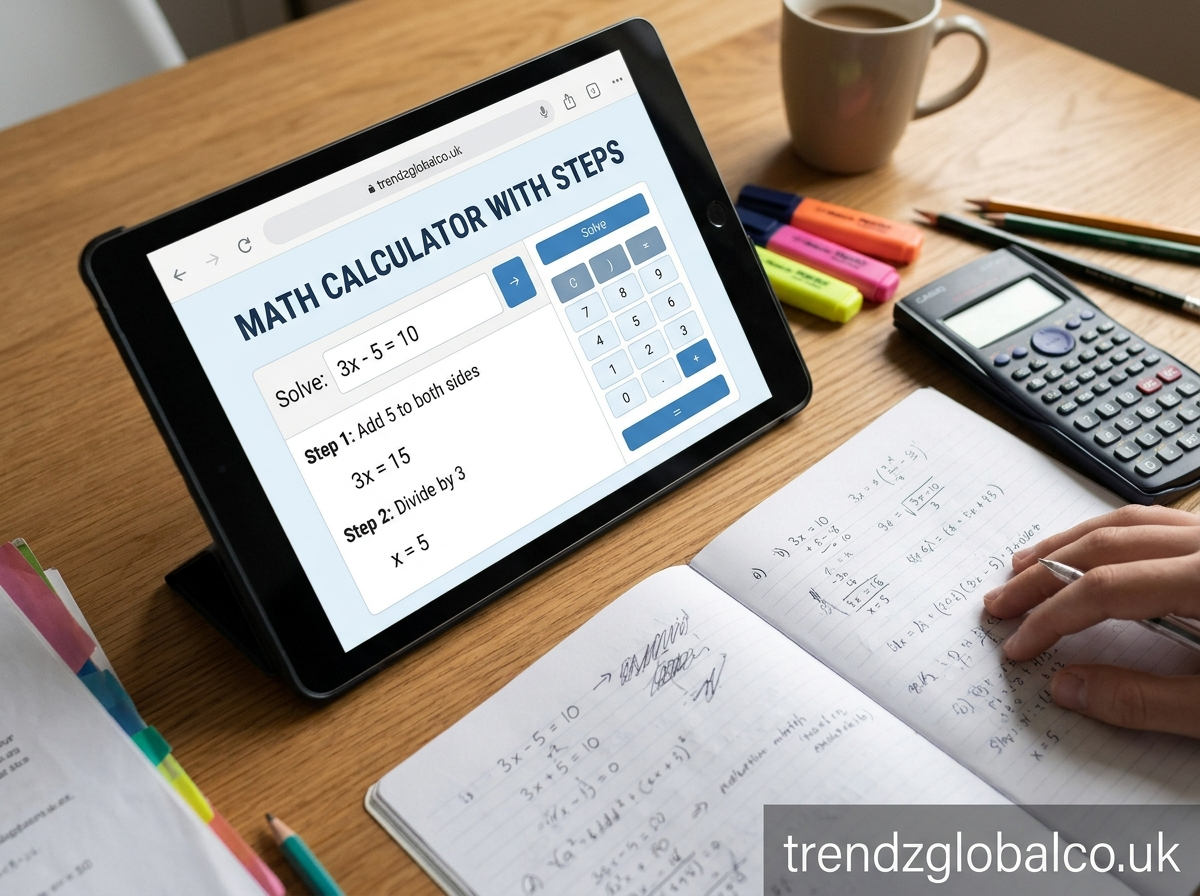
Mathematics becomes easier when you understand how an answer is calculated. A math calculator with steps helps users solve different types of math problems while showing the calculations used to reach the final result. Instead of displaying only an answer, it breaks a problem into smaller parts so users can follow the complete solution.
Students often use these calculators to check homework, understand difficult equations, and practice mathematical operations. Teachers and parents can also use them to explain concepts and review calculations. Whether you are working with basic arithmetic, algebra, fractions, percentages, or calculus, a step-by-step calculator can make the process easier to understand.
This guide explains how a math calculator with steps works, which problems it can solve, how to use it, and how to understand the solutions it provides.
What Is a Math Calculator with Steps?
A math calculator with steps is an online mathematical tool that solves problems and displays the process used to find the answer. A regular calculator usually provides a numerical result after you enter an expression. A step-by-step calculator goes further by explaining the calculations, formulas, and operations involved in reaching that result.
For example, if you enter the equation 2x + 6 = 14, the calculator may show the following process:
First, subtract 6 from both sides:
2x + 6 − 6 = 14 − 6
This gives:
2x = 8
Next, divide both sides by 2:
x = 8 ÷ 2
The final answer is:
x = 4
This approach helps users understand why the answer is 4 instead of simply showing the result. It also makes it easier to identify mistakes and learn the mathematical rules behind a solution.
A math calculator with steps can support different levels of mathematics. Depending on its features, it may handle simple calculations, algebraic expressions, equations, trigonometry, and advanced calculus problems.
How Does a Math Calculator with Steps Work?
A math calculator with steps processes the mathematical expression entered by the user and produces a solution. It identifies the numbers, variables, operators, and mathematical relationships in the problem before applying the appropriate rules.
The exact process depends on the type of calculator and the problem being solved. However, most tools follow a similar approach.
First, the user enters a mathematical expression or equation into the input field. The calculator reads the expression and identifies the required operation. For example, an addition problem requires a different calculation method from a quadratic equation.
Next, the tool applies the relevant mathematical rules. These may include the order of operations, algebraic properties, equation-solving methods, or specific formulas. It then organizes the calculation into smaller steps.
Finally, the calculator displays the result along with the working process. Users can review each stage to understand how the original problem was solved.
For example, consider this expression:
\[ 5 + 3 \times 4 \]
The calculator applies the order of operations. Multiplication comes before addition.
First:
\[ 3 \times 4 = 12 \]
Then:
\[ 5 + 12 = 17 \]
Final answer: 17
This example shows why understanding the steps matters. If someone adds 5 and 3 first, they may get an incorrect result. Following the correct mathematical order produces the right answer.
What Math Problems Can You Solve with a Math Calculator with Steps?
A math calculator with steps can handle many types of mathematical problems. Its available functions depend on the tool, but common calculators support operations ranging from basic arithmetic to more advanced topics.
Basic Arithmetic
Basic arithmetic includes addition, subtraction, multiplication, and division. These operations are used in everyday calculations, school assignments, and financial activities.
For example:
\[ 24 \div 6 + 5 \]
First, divide 24 by 6:
\[ 24 \div 6 = 4 \]
Then add 5:
\[ 4 + 5 = 9 \]
The final answer is 9.
Fractions and Percentages
Fractions and percentages are common in school mathematics and everyday situations. A calculator can help users simplify fractions, find common denominators, convert fractions into decimals, and calculate percentages.
For example, to calculate 25% of 200:
\[ \frac{25}{100}\times 200 \]
\[ 0.25\times 200=50 \]
The answer is 50.
Algebraic Expressions and Equations
Algebra uses letters and symbols to represent unknown values. A step-by-step calculator can help simplify expressions, combine like terms, expand brackets, and solve equations.
For example:
\[ 3x+5x-4 \]
Combine the like terms:
\[ 3x+5x=8x \]
The simplified expression is:
\[ 8x-4 \]
For equations, the calculator can show how to isolate a variable and find its value.
Linear and Quadratic Equations
Linear equations usually involve variables raised to the first power. Quadratic equations contain a variable raised to the second power.
A calculator can solve these equations using methods such as balancing both sides, factoring, completing the square, or applying the quadratic formula.
For example:
\[ x^2-5x+6=0 \]
Factor the expression:
\[ (x-2)(x-3)=0 \]
Set each factor equal to zero:
\[ x-2=0 \]
\[ x-3=0 \]
The solutions are:
\[ x=2,\quad x=3 \]
Exponents and Logarithms
Exponents represent repeated multiplication, while logarithms help find the power needed to produce a particular number.
For example:
\[ 2^3=2\times2\times2=8 \]
A logarithm example is:
\[ \log_2 8=3 \]
A step-by-step calculator can help explain these relationships and solve related expressions.
Geometry and Trigonometry
Geometry involves shapes, angles, lengths, areas, and volumes. Trigonometry focuses on relationships between angles and sides of triangles.
Depending on its supported functions, a math calculator can help with:
- Area and perimeter calculations.
- Circle measurements.
- Triangle problems.
- Sine, cosine, and tangent.
- Pythagorean theorem.
- Angle calculations.
For example, the area of a rectangle is calculated using length multiplied by width. If the length is 8 cm and the width is 5 cm:
\[ A=8\times5=40\text{ cm}^2 \]
Calculus, Derivatives, and Integrals
Advanced calculators may also support calculus problems. Derivatives measure how a function changes, while integrals are used to calculate accumulated quantities and areas under curves.
For example, consider:
\[ f(x)=x^3 \]
Using the power rule for differentiation:
\[ \frac{d}{dx}(x^n)=nx^{n-1} \]
The derivative is:
\[ f'(x)=3x^2 \]
A calculator with calculus support can display the rule and the intermediate steps used to reach the result.
How to Use a Math Calculator with Steps
Using a math calculator with steps is generally straightforward. You do not need advanced mathematical knowledge to enter a problem and review its solution. Follow these steps to get started.
Step 1: Open the Calculator
Open the online math calculator you want to use. Check whether it supports the type of problem you need to solve. Some calculators focus on basic operations, while others support algebra, geometry, and calculus.
Step 2: Enter Your Math Problem
Type your mathematical expression or equation into the input field. Make sure that you enter all numbers, variables, brackets, and mathematical signs correctly.
For example:
\[ 4x+8=20 \]
Step 3: Select the Required Operation
Some calculators automatically identify the problem type. Others may ask you to select an option such as algebra, fractions, percentages, or derivatives.
Choose the appropriate category if the calculator provides one.
Step 4: Generate the Solution
Click the calculate, solve, or submit option. The tool will process the expression and display the result.
Step 5: Review Each Calculation Step
Read the explanation from beginning to end. Pay attention to formulas, substitutions, and mathematical operations. This helps you understand how the answer was obtained.
Step 6: Check the Final Answer
Review the final result and make sure it answers the original question. For equations, you can often substitute the calculated value back into the original equation to verify it.
For example, if the solution is x = 3 for the equation 4x + 8 = 20:
\[ 4(3)+8=20 \]
\[ 12+8=20 \]
\[ 20=20 \]
The answer is correct.
Why Are Step-by-Step Math Solutions Helpful?
Getting the correct answer is useful, but understanding the method behind it is equally important. Step-by-step solutions help users develop mathematical skills instead of depending entirely on final results.
One major benefit is better understanding. When a problem is divided into smaller calculations, students can follow the process without feeling overwhelmed. They can see which mathematical rule is being applied and why a particular operation is necessary.
These explanations also help identify mistakes. If a student gets a different answer from the calculator, comparing the working steps can reveal where the calculation went wrong. The mistake might involve a negative sign, an incorrect formula, or an operation performed in the wrong order.
Step-by-step solutions are also useful for homework and exam preparation. Students can practice a problem independently, compare their work with the calculator’s explanation, and review topics they find difficult.
Teachers and tutors can use these solutions as examples when explaining mathematical concepts. Parents can also follow the calculations to help children with school assignments.
The main advantage is that users can learn the process while checking their answers. This makes a math calculator with steps a useful learning aid for different educational levels.
Math Calculator with Steps vs. Regular Calculator
Both calculators help users perform mathematical operations, but they serve slightly different purposes.
A regular calculator focuses on producing results quickly. It is useful for basic arithmetic, quick calculations, and situations where the user already understands the method.
A math calculator with steps provides additional information. It shows how a problem is solved and may explain the rules or formulas used during the calculation.
For example, when calculating 15 × 8, a regular calculator displays 120. A step-by-step calculator may show the multiplication process or break it into smaller parts.
The difference becomes more noticeable with complex problems. A regular calculator may provide a numerical answer for a supported expression, but it does not necessarily explain how the result was obtained. A step-by-step tool can show the intermediate calculations and make the solution easier to follow.
A regular calculator is suitable for quick numerical work. A math calculator with steps is more useful when you want to understand, check, and learn from a mathematical solution.
Neither option replaces the need to understand mathematical concepts. The right choice depends on whether you need a quick answer or a detailed explanation.
How to Read and Understand Step-by-Step Solutions
Seeing a solution is only the first part of learning. You also need to understand what each step means and how it contributes to the final answer.
Start by looking at the original expression or equation. Identify the numbers, variables, mathematical signs, and any given conditions. This helps you understand what the problem is asking.
Next, follow the operations in the order shown. Pay attention to whether the calculator is simplifying an expression, moving a term across an equation, applying a formula, or performing a substitution.
For example:
\[ 3x-7=11 \]
The first step is to add 7 to both sides:
\[ 3x=18 \]
The next step is to divide both sides by 3:
\[ x=6 \]
Each operation maintains the equality of both sides. Understanding this rule explains why the solution works.
You should also review any formulas used in the calculation. If the problem involves geometry, trigonometry, or calculus, knowing the formula makes the explanation easier to understand.
Finally, check the result whenever possible. Substitute the answer into the original equation or use another calculation method to confirm that the result is reasonable.
Do not skip the intermediate steps simply because the final answer looks correct. Reading the complete solution helps you learn methods that you can apply to similar problems without assistance.
Who Can Benefit from a Math Calculator with Steps?
A math calculator with steps can help people at different educational levels and with different mathematical needs.
School Students: School students can use it to practice arithmetic, fractions, algebra, percentages, and other classroom topics. It can help them understand homework questions and review difficult lessons.
College and University Students: Higher education often involves more advanced mathematical subjects. Students studying engineering, science, economics, and mathematics may use calculators that support equations, matrices, derivatives, integrals, and other complex operations.
Teachers and Tutors: Teachers can use step-by-step solutions as examples during lessons. They can explain how a particular formula works and show students the correct sequence of calculations.
Parents: Parents helping children with homework can use these tools to understand unfamiliar questions and explain the working process at home.
Professionals: People working with measurements, percentages, ratios, and other numerical calculations may use a calculator to check their work and reduce manual calculation errors.
The usefulness of the calculator depends on its supported features and the user’s requirements. Choosing a tool that matches the subject and difficulty level can make mathematical work easier.
Common Mistakes to Avoid When Using a Math Calculator
Although a math calculator with steps can make problem-solving easier, incorrect input or misunderstanding the explanation can still lead to mistakes.
One common mistake is entering the expression incorrectly. Missing brackets, incorrect signs, or misplaced numbers can change the meaning of a mathematical problem. Always review your input before calculating.
Another mistake is ignoring negative signs. For example, -5 + 3 is different from 5 + 3. A small symbol can change the entire result, especially in algebraic expressions.
Using the wrong formula is another issue. Geometry, algebra, and calculus problems require different methods. Make sure the selected formula matches the question you are trying to solve.
Some users also focus only on the final answer. This reduces the learning value of a step-by-step calculator. Read the explanation and understand why each operation is performed.
You should also avoid assuming that every calculator supports every mathematical topic. Some tools may handle basic arithmetic but have limited support for advanced equations or calculus. Check the available features before relying on a calculator for a particular problem.
Finally, do not treat calculator results as automatically correct in every situation. Complex expressions, unsupported notation, incorrect settings, or input errors can affect the result. Review the working and verify important answers independently.
Frequently Asked Questions About Math Calculator with Steps
What is a math calculator with steps?
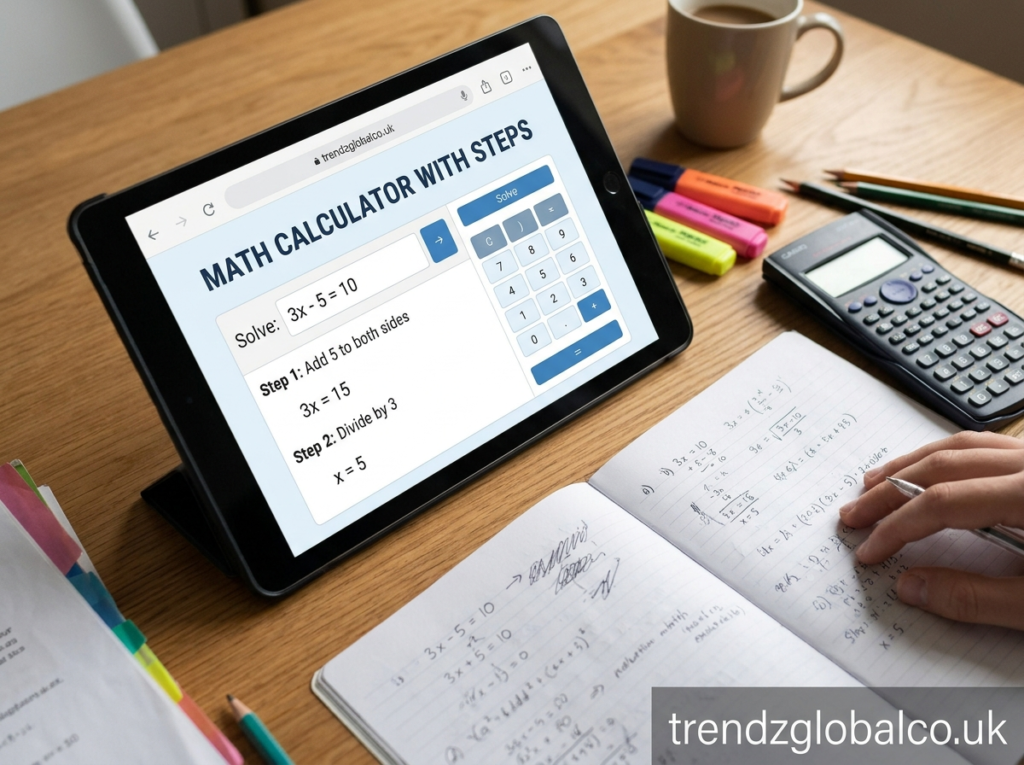
A math calculator with steps is a tool that solves mathematical problems and shows the calculations used to reach the final answer. It helps users understand the working process instead of receiving only a numerical result.
Can a math calculator with steps solve algebra problems?
Yes, calculators with algebra support can solve equations, simplify expressions, combine like terms, expand brackets, and find unknown variables. The available functions depend on the specific calculator.
Does a math calculator show how to get the answer?
Yes. Its main purpose is to display the steps involved in solving a problem. It may show mathematical rules, formulas, substitutions, and intermediate calculations before presenting the final result.
Can I use a math calculator with steps for free?
Many online math calculators offer free access to basic calculations and step-by-step solutions. Some tools may require payment or registration for advanced features, so check their access conditions.
Can it solve fractions and percentages?
Yes, many step-by-step calculators support fraction simplification, fraction operations, decimal conversions, and percentage calculations. They can show how the result is obtained.
Is a step-by-step math calculator useful for students?
Yes. It can help students understand mathematical methods, review homework, identify mistakes, and practice different types of problems. It works best as a learning aid rather than a replacement for independent practice.
Can a math calculator with steps solve complex equations?
Some advanced calculators can solve quadratic equations, systems of equations, logarithmic expressions, and other complex problems. However, the supported problem types vary between tools.
Are step-by-step calculator answers always accurate?
Not necessarily. Results depend on correct input, supported mathematical operations, and the calculator’s calculation methods. Users should review the solution and verify important results.
Conclusion
A math calculator with steps is a useful tool for solving mathematical problems and understanding the process behind each answer. It can support basic arithmetic, fractions, percentages, algebra, equations, geometry, trigonometry, and advanced topics such as calculus, depending on its features.
Its main value is the explanation it provides. Instead of relying only on a final result, users can follow each calculation, understand the formulas, and identify mistakes along the way.
