



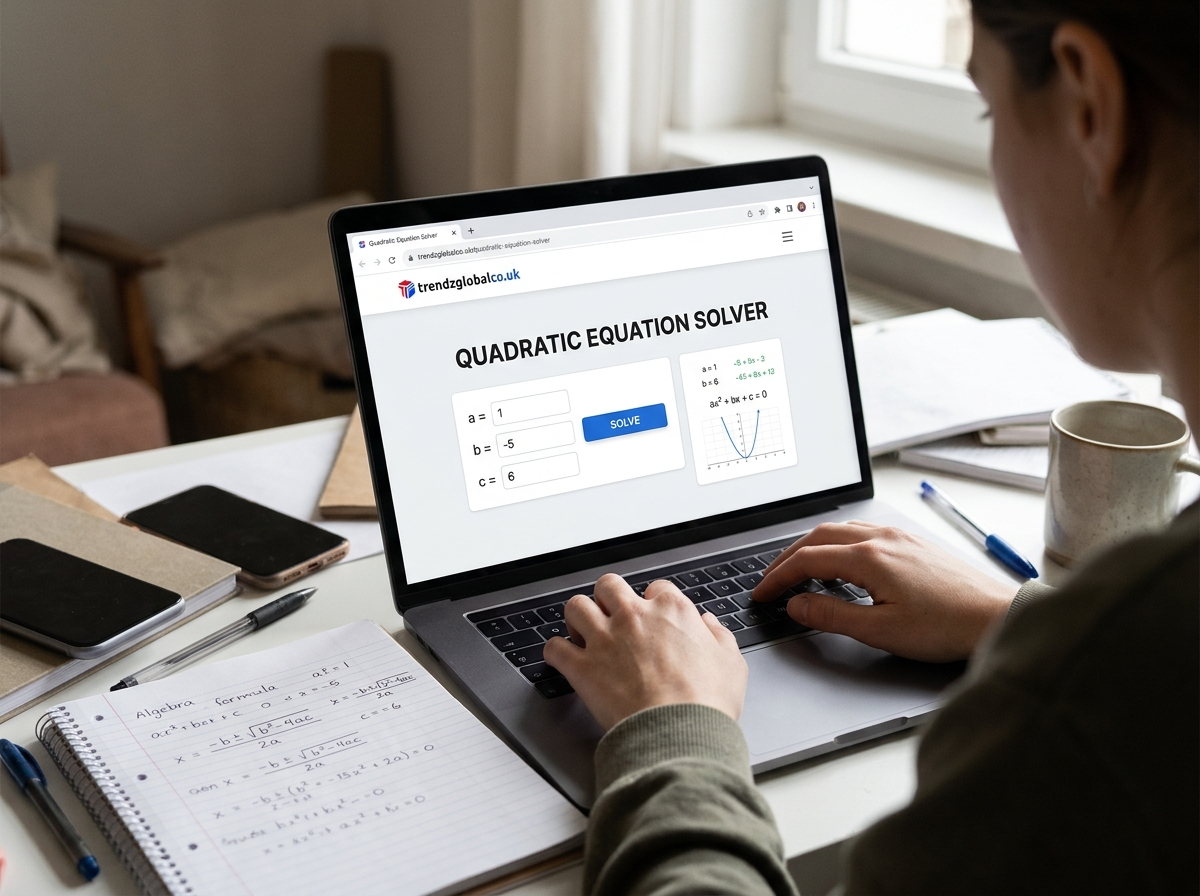
A quadratic equation solver helps you find the values of an unknown variable in a quadratic equation. It can calculate two roots, one repeated root, or complex solutions, depending on the equation. Students, teachers, and mathematics learners use these tools to solve problems, check homework, and understand mathematical calculations.
A quadratic equation usually contains a variable raised to the power of two. Its standard form is \(ax^2+bx+c=0\), where a, b, and c represent numerical coefficients. Although some quadratic equations are easy to solve by factoring, others require the quadratic formula or completing the square.
An online quadratic equation solver makes these calculations easier by processing the equation and showing its solutions. Understanding how the calculator works is also useful because it helps you recognize the correct method and check whether an answer makes sense.
What Is a Quadratic Equation Solver?
A quadratic equation solver is a mathematical tool that finds the roots of an equation containing a variable with an exponent of two. These roots are the values of the variable that make the equation equal to zero.
For example, consider this equation:
\[ x^2-5x+6=0 \]
The solutions are \(x=2\) and \(x=3\). Substituting either value into the original equation produces zero.
A quadratic equation solver performs this calculation automatically. Depending on the calculator, users can enter the complete equation or provide the coefficients a, b, and c separately. The tool then applies an appropriate mathematical method to calculate the roots.
These calculators are useful for students working on algebra assignments, teachers preparing examples, and anyone who wants to verify a mathematical result. Some tools also display calculation steps, making it easier to understand how the final answer was obtained.
What Is the Standard Form of a Quadratic Equation?
The standard form of a quadratic equation is:
\[ ax^2+bx+c=0 \]
Each letter represents a specific part of the equation.
- a: The coefficient of the squared variable.
- b: The coefficient of the variable with the first power.
- c: The constant term.
The value of a must not be zero. If a equals zero, the squared term disappears, and the equation becomes linear rather than quadratic.
Consider this example:
\[ 3x^2+7x+2=0 \]
In this equation, a = 3, b = 7, and c = 2. These three values are enough to use the quadratic formula or an online quadratic equation solver.
A quadratic equation can also contain negative coefficients, fractions, or missing terms. For example, \(x^2-9=0\) has no middle term, so b equals zero. The equation \(2x^2+5x=0\) has no constant term, so c equals zero.
Recognizing the standard form is the first step toward solving these problems correctly. If an equation is written differently, rearrange it until all terms are on one side and the other side equals zero.
How Does an Online Quadratic Equation Solver Work?
An online quadratic equation solver uses mathematical formulas and calculation rules to find the roots of a quadratic equation. It processes the numbers entered by the user and determines which method can produce the correct solutions.
Most calculators follow a similar process. First, the user enters an equation or provides its three coefficients. The calculator identifies the values of a, b, and c. It then uses these values in the quadratic formula or another supported solving method.
The tool calculates the discriminant, which helps determine the type of solutions. It then performs the remaining operations, including subtraction, multiplication, division, and square-root calculations.
For example, suppose you enter:
\[ x^2-7x+12=0 \]
The calculator identifies:
\[ a=1,\quad b=-7,\quad c=12 \]
It then calculates the roots:
\[ x=3,\quad x=4 \]
Some calculators display only the final answers, while others show the complete calculation process. A step-by-step result is especially helpful when you are learning algebra because you can compare the calculator’s method with your own working.
How to Solve a Quadratic Equation Step by Step
There are several ways to solve quadratic equations. The best method depends on the numbers and structure of the equation. Four commonly used methods are factoring, the quadratic formula, completing the square, and the square root method.
1. Factoring Method
Factoring means rewriting a quadratic expression as a product of two smaller expressions. Each factor can then be set equal to zero to find the roots.
Consider:
\[ x^2-5x+6=0 \]
Find two numbers whose product is 6 and whose sum is -5. These numbers are -2 and -3.
Rewrite the equation:
\[ (x-2)(x-3)=0 \]
Set each factor equal to zero:
\[ x-2=0 \]
\[ x-3=0 \]
Therefore:
\[ x=2,\quad x=3 \]
Factoring is often the quickest method when an equation contains simple integer factors.
2. Quadratic Formula Method
The quadratic formula works for every quadratic equation when the coefficients are correctly identified.
The formula is:
\[ x=\frac{-b\pm\sqrt{b^2-4ac}}{2a} \]
Consider:
\[ x^2+4x-5=0 \]
The coefficients are a = 1, b = 4, and c = -5.
Substitute these values:
\[ x=\frac{-4\pm\sqrt{4^2-4(1)(-5)}}{2(1)} \]
Simplify the expression:
\[ x=\frac{-4\pm\sqrt{36}}{2} \]
\[ x=\frac{-4\pm6}{2} \]
Calculate both possible answers:
\[ x=\frac{-4+6}{2}=1 \]
\[ x=\frac{-4-6}{2}=-5 \]
The two solutions are \(x=1\) and \(x=-5\).
3. Completing the Square Method
Completing the square changes a quadratic expression into a perfect square. This method is useful when factoring is difficult or when you need to understand how the quadratic formula is derived.
Consider:
\[ x^2+6x+5=0 \]
Move the constant to the other side:
\[ x^2+6x=-5 \]
Take half of the coefficient of x and square it:
\[ \left(\frac{6}{2}\right)^2=9 \]
Add 9 to both sides:
\[ x^2+6x+9=4 \]
Rewrite the left side as a perfect square:
\[ (x+3)^2=4 \]
Take the square root of both sides:
\[ x+3=\pm2 \]
Therefore:
\[ x=-3\pm2 \]
The solutions are:
\[ x=-1,\quad x=-5 \]
4. Square Root Method
The square root method is useful when an equation can be written with a squared variable or expression on one side.
Consider:
\[ x^2=25 \]
Take the square root of both sides:
\[ x=\pm\sqrt{25} \]
Therefore:
\[ x=5,\quad x=-5 \]
Both positive and negative values must be considered because their squares are equal.
What Is the Quadratic Formula?
The quadratic formula is a standard mathematical rule used to calculate the roots of a quadratic equation. It is particularly helpful when an equation cannot be factored easily.
The formula is:
\[ x=\frac{-b\pm\sqrt{b^2-4ac}}{2a} \]
It contains three coefficients taken from the standard equation \(ax^2+bx+c=0\).
The letter a represents the coefficient of the squared variable, b represents the coefficient of x, and c represents the constant. The symbol ± means that two calculations are required: one using addition and another using subtraction.
For example:
\[ 2x^2-4x-6=0 \]
Identify the coefficients:
\[ a=2,\quad b=-4,\quad c=-6 \]
Substitute them into the formula:
\[ x=\frac{-(-4)\pm\sqrt{(-4)^2-4(2)(-6)}}{2(2)} \]
Simplify:
\[ x=\frac{4\pm\sqrt{16+48}}{4} \]
\[ x=\frac{4\pm8}{4} \]
Calculate both results:
\[ x=\frac{12}{4}=3 \]
\[ x=\frac{-4}{4}=-1 \]
The final answers are \(x=3\) and \(x=-1\).
A quadratic equation solver applies the same formula automatically. However, learning how to substitute the coefficients helps you understand where the answers come from and identify mistakes in your calculations.
What Is the Discriminant in a Quadratic Equation?
The discriminant is the part of the quadratic formula found under the square root symbol. It determines the number and type of roots a quadratic equation has.
Its formula is:
\[ D=b^2-4ac \]
The discriminant can be positive, zero, or negative. Each result has a different meaning.
Positive discriminant (D greater than 0): The equation has two different real roots. For example:
\[ x^2-5x+6=0 \]
Here, the discriminant is:
\[ D=(-5)^2-4(1)(6)=1 \]
Since the result is positive, the equation has two distinct real solutions.
Zero discriminant (D equals 0): The equation has one repeated real root. For example:
\[ x^2-6x+9=0 \]
Its discriminant is:
\[ D=(-6)^2-4(1)(9)=0 \]
The repeated root is x = 3.
Negative discriminant (D less than 0): The equation has two complex conjugate roots rather than real-number solutions. For example:
\[ x^2+2x+5=0 \]
Its discriminant is:
\[ D=2^2-4(1)(5)=-16 \]
The solutions are:
\[ x=-1\pm2i \]
An online quadratic equation solver uses the discriminant to identify which type of result should be displayed.
Types of Solutions in Quadratic Equations
Quadratic equations can produce different types of answers depending on their coefficients. Understanding these results makes it easier to interpret the output of a calculator.
Two distinct real solutions: When the discriminant is positive, the equation has two different real roots. Both answers satisfy the original equation. For example, \(x^2-9=0\) produces x = 3 and x = -3.
One repeated real solution: When the discriminant equals zero, both roots have the same value. For example, \(x^2-4x+4=0\) has the repeated root x = 2.
Two complex solutions: When the discriminant is negative, the equation has no real roots but has two complex solutions. These answers contain the imaginary unit i, where \(i^2=-1\).
A quadratic equation solver can help identify these possibilities without requiring users to perform every calculation manually. This is particularly useful when working with equations that produce decimal or complex results.
How to Use a Quadratic Equation Solver Online
Using an online quadratic equation solver is usually straightforward. Most tools provide an input field where you can enter an equation or supply its coefficients.
Start by writing the equation in standard form:
\[ ax^2+bx+c=0 \]
Identify the values of a, b, and c. Make sure you include the correct positive or negative signs because an incorrect coefficient can change the final answer.
Enter the equation or its coefficients into the calculator. Once the values are entered, select the solve or calculate option. The calculator processes the equation and displays the roots.
If the tool provides detailed working, review the discriminant and the steps used to calculate the solutions. This can help you understand the result instead of simply copying the final numbers.
For example, if you enter \(x^2-8x+15=0\), the calculator should return:
\[ x=3,\quad x=5 \]
You can check these answers by substituting them into the original equation. If the equation equals zero for both values, the solutions are correct.
Benefits of Using a Quadratic Equation Solver
A quadratic equation solver can make algebra calculations easier, particularly when you are working with several equations or unfamiliar problems.
One major benefit is that it saves time. Instead of manually applying the quadratic formula and calculating square roots, users can enter the coefficients and receive the result quickly.
It also helps reduce arithmetic mistakes. Negative signs, fractions, and square-root calculations can cause errors during manual work. A reliable calculator handles these operations consistently when the correct equation is entered.
Another advantage is answer verification. Students can solve an equation independently and compare their results with the calculator’s output. This makes it easier to identify where a calculation went wrong.
Some online solvers also provide step-by-step explanations. These features are useful for understanding the quadratic formula, factoring, and the discriminant. Students can study the process and apply the same method to similar questions.
However, a calculator should support learning rather than replace it. Practicing the solving methods is still necessary for examinations and situations where online tools are not available.
Common Mistakes to Avoid When Solving Quadratic Equations
Many errors in quadratic equations happen because of incorrect coefficient identification or mistakes during calculations.
A common mistake is entering the wrong sign. For example, in \(x^2-5x+6=0\), the value of b is -5, not 5. Using the wrong sign changes the result of the quadratic formula.
Another mistake is forgetting that the coefficient a cannot equal zero. When a is zero, the expression is no longer a quadratic equation.
Students also sometimes forget the ± symbol in the quadratic formula. This symbol requires two calculations and can produce two different roots. Using only the positive square root may cause one solution to be missed.
Incorrect square-root calculations are another source of errors. Always simplify the expression carefully and check whether the discriminant is positive, zero, or negative.
Finally, some students assume every quadratic equation has two real answers. A negative discriminant produces complex roots, so a calculator that supports complex numbers may be needed to display the complete result.
Checking the final answers by substituting them into the original equation is a simple way to catch many of these mistakes.
Real-Life Applications of Quadratic Equations
Quadratic equations are not limited to classroom exercises. They are used in several areas of mathematics, science, engineering, and everyday problem-solving.
In physics, quadratic equations help describe projectile motion. When an object is thrown into the air, its height changes over time. A quadratic expression can represent this movement and help calculate when the object reaches a particular height or returns to the ground.
Engineering also uses quadratic equations when analyzing curves, designing structures, and working with certain motion and measurement problems. Architects may use parabolic shapes in roofs, bridges, and other structural designs.
In business and economics, quadratic equations can represent revenue, cost, and profit relationships. A business may use a quadratic model to study how changes in production or selling prices affect profit.
Geometry provides another example. Quadratic equations can help calculate the dimensions of shapes when their area or other measurements are known.
These applications show why understanding quadratic equations is useful beyond algebra lessons. An online solver can help calculate the mathematical results, while knowledge of the underlying method helps explain what those results mean.
Frequently Asked Questions About Quadratic Equation Solver
1. What is a quadratic equation solver?
A quadratic equation solver is an online mathematical tool that calculates the roots of equations containing a squared variable. It can solve equations using the quadratic formula and may also display the calculation steps.
2. How do I solve a quadratic equation step by step?
First, write the equation in standard form \(ax^2+bx+c=0\). Identify the coefficients, select a solving method, and calculate the roots. You can use factoring, completing the square, or the quadratic formula.
3. What is the formula for solving quadratic equations?
The quadratic formula is:
\[ x=\frac{-b\pm\sqrt{b^2-4ac}}{2a} \]
Here, a, b, and c are the coefficients of the standard quadratic equation.
4. Can a quadratic equation solver give complex roots?
Yes. A calculator that supports complex numbers can display complex roots when the discriminant is negative. These solutions include the imaginary unit i.
5. How do I find the roots of a quadratic equation?
You can find the roots by factoring the equation or using the quadratic formula. The roots are the values of x that make the equation equal to zero.
6. What happens when the discriminant is zero?
When the discriminant equals zero, the equation has one repeated real root. Both solutions have the same numerical value.
7. Can I solve quadratic equations online for free?
Yes. Many websites provide free quadratic equation calculators. Some offer basic answers, while others show the calculation process and different types of solutions.
8. Is a quadratic equation solver accurate?
A properly functioning solver can calculate accurate results when the equation and coefficients are entered correctly. Users should still check the input and verify the answers by substituting them into the original equation.
Conclusion
A quadratic equation solver is a useful tool for finding the roots of quadratic equations without performing every calculation manually. It can handle different types of equations and help users identify real, repeated, and complex solutions.
Understanding the standard form, quadratic formula, discriminant, and different solving methods makes it easier to work with these problems. Factoring is helpful for simple equations, while the quadratic formula provides a reliable method for more difficult calculations.
Whether you are completing algebra homework, preparing for an examination, or checking mathematical answers, an online quadratic equation solver can save time and help you verify your work. For the best results, combine calculator use with regular practice so you understand how each solution is calculated.
