



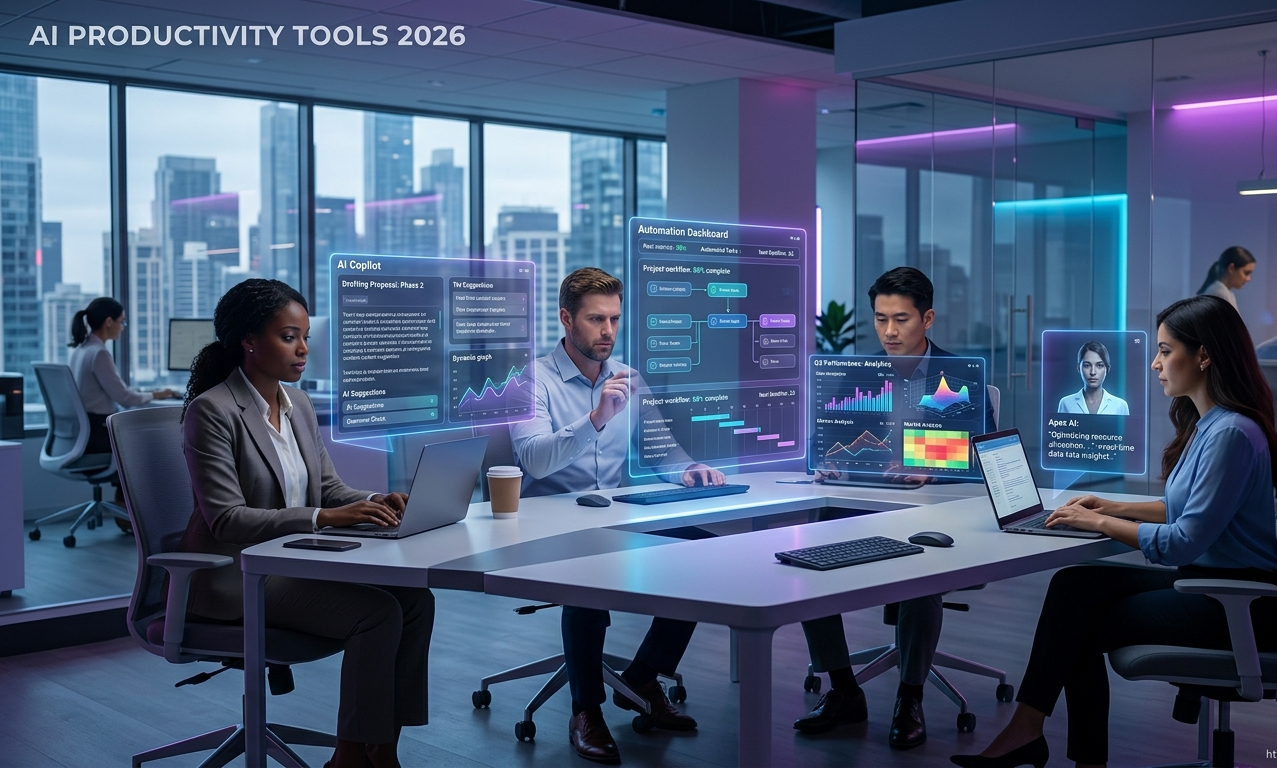
Artificial intelligence has reached a turning point in 2026. What once felt like experimental technology has now become deeply embedded in everyday work. From writing emails to managing complex workflows, AI productivity tools are no longer optional—they are becoming essential for individuals and organizations trying to stay competitive in a rapidly evolving digital environment.
The biggest shift is not just technological but behavioral. Professionals are no longer asking whether they should use AI tools, but how to use them effectively. This article explores the latest updates in AI productivity tools in 2026, including key trends, real-world performance, major tools, challenges, and what the future holds. Every section is grounded in research and practical insights to help you understand how AI is truly reshaping productivity.
The Evolution of AI Productivity Tools in 2026
AI productivity tools in 2026 have evolved from simple assistants into intelligent systems capable of handling complex workflows. Earlier tools focused mainly on automation of repetitive tasks such as email drafting or summarization. Now, they operate as integrated systems that support decision-making, content creation, and execution across multiple domains.
One of the most significant developments is the transition from isolated tools to fully integrated ecosystems. Modern productivity platforms embed AI directly into their interfaces, eliminating the need to switch between apps. This allows users to write, analyze, automate, and collaborate within a single environment. Research shows that this seamless integration reduces friction and improves efficiency by aligning AI capabilities with natural workflows rather than forcing users to adapt to new systems.
Another key evolution is the maturity of AI capabilities. Tools are now more reliable, context-aware, and capable of handling nuanced tasks. Instead of generating generic outputs, they can adapt to user preferences, organizational data, and specific goals. This shift marks the transition from experimental AI to practical, real-world productivity solutions.
The Rise of AI Agents and Autonomous Workflows
One of the most important updates in 2026 is the emergence of AI agents. Unlike traditional AI tools that respond to prompts, AI agents can perform multi-step tasks autonomously. They plan, execute, and refine workflows with minimal human intervention, making them far more powerful than earlier systems.
Recent research highlights that AI agents are finally delivering real value because they operate within clearly defined environments. Rather than trying to handle everything, they focus on specific workflows such as coding, research, or customer support. This targeted approach improves reliability and makes them genuinely useful in professional settings.
These agents are already being used in areas like software development, where they can write and refactor code, or in business operations, where they manage tasks such as scheduling, reporting, and communication. The shift toward autonomous workflows is redefining productivity, as users move from performing tasks themselves to supervising AI-driven processes.
AI Copilots Becoming the Default Interface
In 2026, AI copilots have become the standard interface across productivity tools. Whether working in documents, spreadsheets, email, or coding environments, users now interact with AI as a built-in assistant rather than a separate feature.
This transformation is significant because it removes the barrier to AI adoption. Users no longer need specialized knowledge to benefit from AI. Instead, they simply describe what they want, and the system generates results. This has led to widespread adoption across industries, as even non-technical users can leverage advanced AI capabilities.
Copilots are also improving collaboration by acting as intermediaries between users and complex systems. They can summarize conversations, generate reports, and suggest next steps in real time. This reduces cognitive load and allows teams to focus on strategic thinking rather than routine tasks.
Multimodal AI and Unified Workflows
Another major trend in AI productivity tools is the rise of multimodal AI. These systems can process and generate multiple types of content, including text, images, audio, video, and structured data, within a single interface.
This capability is transforming how work is done. For example, users can upload documents, analyze data, generate visuals, and create presentations without switching tools. Multimodal AI enables more natural interactions, such as speaking instructions or uploading images for analysis, making workflows faster and more intuitive.
The impact of this trend is particularly evident in creative and analytical work. Professionals can now move seamlessly between different types of tasks, reducing fragmentation and improving efficiency. As a result, multimodal AI is becoming a cornerstone of modern productivity systems.
Real-World Productivity Gains and Performance Data
While AI tools promise significant productivity improvements, real-world results are more nuanced. Some studies show substantial gains, particularly in routine tasks and unfamiliar workflows. For example, AI-assisted coding can be 40–60% faster for standard tasks and significantly faster when working with new codebases.
However, other research highlights limitations. In certain scenarios, AI tools can actually slow down work, especially when outputs require extensive verification or correction. A study on developers found that AI usage sometimes increased task completion time due to the need for careful review and debugging.
These mixed results suggest that productivity gains depend heavily on how AI is used. When applied to the right tasks with proper oversight, AI can deliver significant benefits. However, misuse or over-reliance can lead to inefficiencies, emphasizing the importance of strategic implementation.
Popular AI Productivity Tools in 2026
The AI productivity landscape in 2026 is dominated by a mix of general-purpose and specialized tools. General AI assistants are widely used for tasks such as writing, research, coding, and problem-solving. These tools serve as central hubs for productivity, allowing users to handle multiple tasks within a single platform.
According to community insights and industry discussions, tools like ChatGPT, Google Gemini, and Microsoft 365 Copilot are among the most widely adopted solutions. They are valued for their versatility, integration with existing workflows, and ability to handle diverse tasks efficiently.
Specialized tools are also gaining traction. Platforms focused on automation, design, video editing, and knowledge management are becoming essential for specific workflows. The combination of general and specialized tools creates a flexible ecosystem that supports a wide range of productivity needs.
Automation and the Elimination of Bottlenecks
Automation remains one of the most powerful benefits of AI productivity tools. In 2026, the focus has shifted from simple task automation to eliminating workflow bottlenecks that limit productivity.
Common bottlenecks include scheduling conflicts, inefficient research processes, excessive meetings, and fragmented knowledge systems. AI tools address these issues by automating repetitive tasks, organizing information, and providing actionable insights.
The result is a more streamlined workflow where users spend less time on administrative tasks and more time on meaningful work. This shift is particularly valuable in knowledge-intensive industries, where efficiency and decision-making speed are critical.
Challenges, Risks, and Limitations of AI Tools
Despite their advantages, AI productivity tools come with several challenges. One of the most significant issues is accuracy. AI-generated content often requires human review, which can reduce efficiency if not managed properly.
Another major concern is over-reliance. As users depend more on AI, there is a risk of reduced critical thinking and skill development. Additionally, the rapid growth of AI tools has led to tool overload, where users struggle to choose and manage multiple platforms effectively.
There are also important considerations around data privacy and governance. Organizations must ensure that sensitive information is handled securely and that AI usage complies with regulations. In 2026, AI governance is no longer optional but a critical component of responsible adoption.
Measuring Productivity in the AI-Driven Workplace
Measuring productivity in the age of AI is becoming increasingly complex. Traditional metrics such as hours worked or tasks completed are no longer sufficient to capture the true impact of AI tools.
New approaches focus on outcomes rather than activity. For example, organizations are beginning to measure productivity based on value creation, quality of work, and business impact. This shift reflects the reality that AI changes not just how work is done, but also how success is defined.
Recent industry discussions highlight the need for better metrics to evaluate AI performance. Companies are experimenting with new frameworks to measure meaningful output rather than superficial indicators, signaling a broader transformation in productivity measurement.
The Future of AI Productivity Tools Beyond 2026
Looking ahead, AI productivity tools are expected to become even more advanced and deeply integrated into daily work. Future developments will likely include more autonomous AI agents, improved personalization, and enhanced collaboration between humans and machines.
At the same time, organizations will need to focus on responsible AI adoption. This includes balancing efficiency with ethical considerations, ensuring transparency, and supporting employee well-being. The goal is not just to increase productivity, but to create sustainable and meaningful work environments.
Ultimately, the future of AI productivity lies in human-AI collaboration. The most successful individuals and organizations will be those that use AI strategically, combining its capabilities with human creativity, judgment, and expertise.
Conclusion
AI productivity tools in 2026 are transforming the way work is performed across industries. From autonomous AI agents to integrated copilots and multimodal systems, these tools are reshaping workflows, improving efficiency, and redefining productivity
