



Solve Math: The 4-Step Method to Solve Any Maths Problem
Quick answer: To solve math problems reliably, use the same four steps every time: understand the problem, plan which method fits it, solve it one careful line at a time, and check the answer before moving on. This method works for every topic — equations, ratio, geometry, percentages, indices — because it replaces guessing with a routine. And when you are truly stuck, an online solver can show you a worked solution to learn from.
Most people think solving maths is about remembering dozens of separate tricks, one per topic. It is not. Good problem-solvers run the same quiet routine on every question, whatever the topic — a routine first described by the mathematician George Pólya and still taught today because it works. This guide teaches you that routine, then shows it in action with six short topic examples: simultaneous equations, simplifying expressions, ratio, Pythagoras, simple interest, and indices. None of this needs special talent. It needs a method — and a method can be learned. For the wider background on solver tools themselves, our general math solver guide to solving maths problems online is a good companion read.
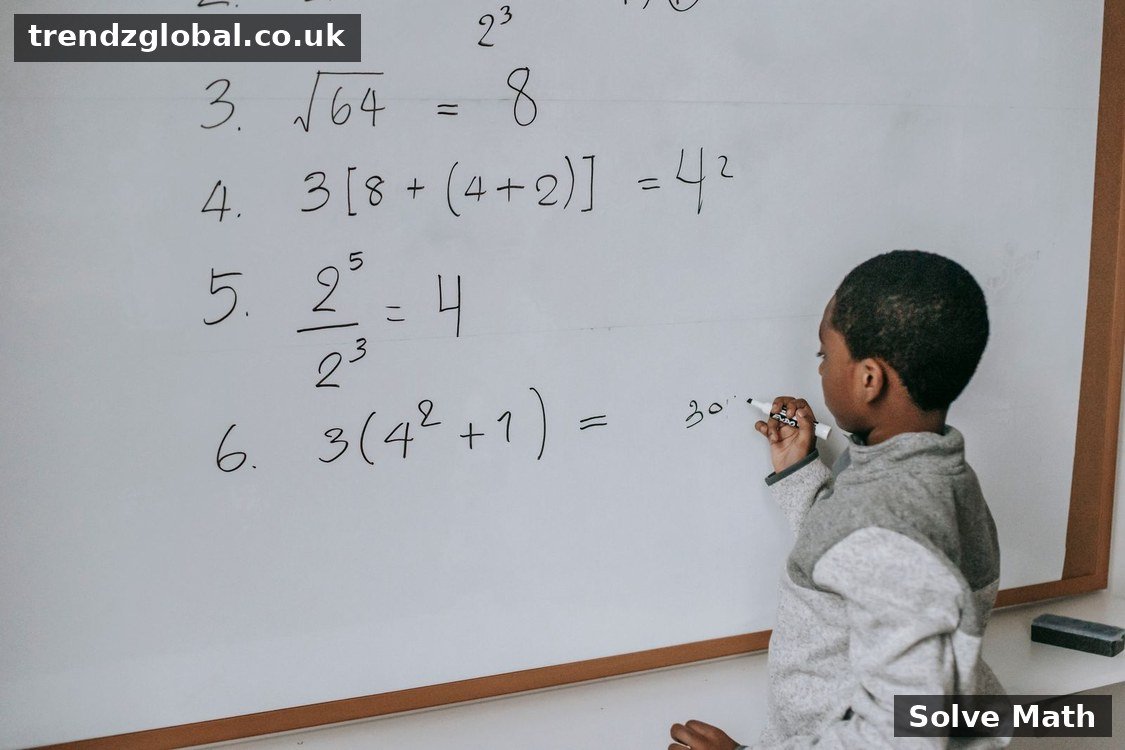
How to Solve Math Problems: The Quick Answer
Strip away the topic and every maths problem asks the same three things: What is given? What is wanted? Which rule connects them? If you can answer those, you can solve math questions in any chapter of the textbook, because the “hard part” is almost never the arithmetic — it is choosing the right first move. The four steps below force that first move into the open. Practise them on easy questions until they are automatic, and harder questions simply become longer versions of the same routine. A math solver with solution follows exactly this logic too, which is why its worked answers are worth studying rather than copying.
The Universal 4-Step Method to Solve Math Problems
Step 1: Understand the Problem
Read the question twice. On the first read, get the story: what is happening, what are the numbers, what is being asked? On the second read, hunt for the exact quantity you must find and underline it. Then write down, in symbols if you can, what you know and what you want. If the problem is in words, translate it: “a number increased by 5” becomes x + 5; “shared between” signals a ratio or a division. Most wrong answers are born here — not from bad maths, but from solving a slightly different problem from the one that was asked.
Step 2: Make a Plan
Ask: have I seen this shape before? Name the method before you touch the numbers — “this is a Pythagoras question”, “this needs elimination”, “this is simple interest, so I need the formula I = PRT/100”. Choosing the method first stops the most common panic response, which is doing random operations on the given numbers and hoping. If two methods could work, pick the one you have practised most; a familiar method done carefully beats a clever one done shakily. This is also the step where topic-specific tools earn their keep — a quadratic equation solver for ax² + bx + c = 0 equations, for instance, exists precisely because quadratics have a set plan: factorise, or use the formula.
Step 3: Carry Out the Plan
Now solve — slowly, one transformation per line, writing each line under the last. One change per line is the golden rule: it keeps the working readable, and if the answer is wrong you can find the exact line where it went wrong instead of starting again. Keep equals signs aligned in equations. Do not do two steps “in your head” to save time; head-steps are where sign errors hide. If the plan stalls halfway, that is information, not failure — go back to Step 2 and choose a different route.

Step 4: Check Your Answer
Never skip this step — it is what separates students who solve math problems from students who hope they have. You have four fast checks: substitute back (put your answer into the original question), estimate (is the size sensible?), reverse it (undo your last operation and see if you land back at the start), and re-read the question (did you answer what was actually asked, in the units asked for?). A math calculator with steps that shows every stage of working makes the substitution check painless, because you can compare its lines with yours. Thirty seconds of checking rescues more marks than thirty minutes of extra solving.
Quick Methods by Topic: Six Mini-Examples
Here is the 4-step method applied at speed. Each example is short: the plan in one phrase, the working in a few lines, and the check that proves it.
Simultaneous Equations
Problem: Solve x + y = 10 and x − y = 4. Plan: the y terms cancel if we add, so use elimination. Adding the equations: 2x = 14, so x = 7. Substitute into the first: 7 + y = 10, so y = 3. Check: 7 + 3 = 10 ✓ and 7 − 3 = 4 ✓ — both originals satisfied, so the pair is right.
Simplifying an Algebraic Expression
Problem: Simplify 5a + 3b − 2a + 7b. Plan: collect like terms — a’s with a’s, b’s with b’s. 5a − 2a = 3a, and 3b + 7b = 10b, giving 3a + 10b. Check: test with a = 2, b = 1: the original gives 10 + 3 − 4 + 7 = 16, and the simplified form gives 6 + 10 = 16 ✓. Substituting numbers is the perfect check for any simplification.
Sharing an Amount in a Ratio
Problem: Share £60 in the ratio 2 : 3. Plan: find the value of one part. Total parts = 2 + 3 = 5, so one part = £60 ÷ 5 = £12. The shares are 2 × £12 = £24 and 3 × £12 = £36. Check: £24 + £36 = £60 ✓ (nothing lost), and 24 : 36 simplifies back to 2 : 3 ✓.

Pythagoras’ Theorem
Problem: A right-angled triangle has shorter sides 6 cm and 8 cm. Find the hypotenuse. Plan: the hypotenuse squared equals the sum of the other squares. So c² = 6² + 8² = 36 + 64 = 100, and c = √100 = 10 cm. Check: 10² = 100, and 36 + 64 = 100 ✓. Also sanity-check the size: the hypotenuse must be the longest side, and 10 is longer than 8 ✓.
Simple Interest
Problem: Find the interest on £500 at 4% per year for 3 years. Plan: use I = P × R × T ÷ 100. I = 500 × 4 × 3 ÷ 100 = £60. Check: work it year by year — 4% of £500 is £20 per year, and £20 × 3 years = £60 ✓. Two routes, same answer.
Indices (Exponents)
Problem: Simplify 2³ × 2⁴. Plan: when multiplying powers with the same base, add the indices: 2³ × 2⁴ = 2⁷. As a number, 2⁷ = 128. Check: expand instead — 2³ = 8 and 2⁴ = 16, and 8 × 16 = 128 ✓. When a rule feels abstract, expanding it once makes it stick.
How to Solve Math Problems Online
Sometimes the fastest way to learn a problem is to watch it solved properly. Online, you have three routes. Type it: enter the problem into an online math solver — a good math solver with steps shows the full working, not just the answer — using brackets carefully — 5(x − 2) is not 5x − 2. Photo it: a free photo math solver that reads problems from a picture scans your page and solves what it sees — always confirm it read every symbol correctly. Ask an AI solver: a modern maths solver ai accepts questions in plain words and explains the reasoning, which is ideal for word problems.
Whichever route you choose, use the output as a lesson, not a shortcut: compare its steps with your plan, find where yours differed, then close it and solve a similar problem alone. Our round-up of the best free ai math solver tools and how free AI solvers work compares the free options, and our explainer on how a maths solver ai works and how accurate it is shows what happens behind the screen. People often search “solver math” plus their topic to find these tools — however you arrive, the learning rule is the same: attempt first, then compare.

Stuck? What to Do When a Problem Won’t Budge
- Re-read and re-translate. Say the problem in your own words. Half of all “impossible” problems are misunderstandings, not maths.
- Shrink it. Replace the numbers with tiny ones — solve the easy twin first, spot the pattern, then return to the real numbers.
- Work backwards. Start from the answer the question wants and ask what must be true one step before it.
- Draw it. A sketch for geometry, a number line for negatives, a table for ratio — pictures expose structure that symbols hide.
- Study one worked example, then retry. Read a single solution from a math solver step by step guide with worked examples, close it, and redo your problem from a blank page.
- Park it and return. Ten minutes on another question often unlocks the stuck one; your brain keeps working in the background. In an exam, this also protects the marks on easier questions.
Notice what is not on this list: staring, and copying an answer you do not understand. An ai maths solver can rescue the homework, but only the strategies above rescue the understanding — and understanding is what the next, harder problem will test. The same goes for advanced topics: even calculus yields to the routine, as an integral solver that explains integration step by step demonstrates — understand what is asked, plan the rule, apply it line by line, and check by differentiating.

Frequently Asked Questions
What is the easiest way to solve math problems?
Use the same four steps every time: understand what is asked, plan which method fits, solve one line at a time, and check the answer. A fixed routine removes the guesswork of “where do I start?”, which is where most problems actually go wrong.
How can I solve math word problems?
Translate before you calculate. Read twice, underline the quantity you must find, and rewrite the words as symbols — “increased by” means add, “of” usually means multiply, “shared in the ratio” means divide into parts. Once translated, a word problem is just an ordinary problem in a costume.
Can I solve math problems online for free?
Yes. Free solver websites and apps let you type or photograph a problem and see a full worked solution. Use them to learn the method — attempt the question first, compare steps, then solve a similar one unaided — rather than copying answers, which collapses in exams.
Why do I keep getting maths problems wrong when I know the method?
Usually one of three reasons: rushing Step 1 and solving the wrong problem, doing two operations in one line and dropping a sign, or never checking. Slow the first step down, write one change per line, and always substitute your answer back — those three habits fix most careless errors.
How do I check my answer without a teacher?
Substitute the answer into the original question and confirm it works. For simplifications, test both versions with small numbers. For money and measurement answers, estimate the sensible size first. And for integrals, differentiate your answer — you should land back at the starting function.
What should I do when I am completely stuck on a problem?
Re-read it in your own words, try a version with smaller numbers, draw a picture or table, or study one worked example and then retry from a blank page. If it still resists, park it and come back — and in homework, note the exact step where you got stuck, because that is the most useful thing to ask a teacher about.
Conclusion
You do not need a different trick for every topic to solve math well — you need one routine you trust: understand the problem, plan the method, solve it line by line, and check the answer. The six mini-examples above — simultaneous equations, simplifying, ratio, Pythagoras, simple interest, and indices — all yielded to those same four steps, and so will the topics waiting further up the course. Build the routine on easy questions, use online solvers as worked examples rather than answer machines, and treat being stuck as a stage with its own strategies. Do that, and “solve math” stops being a talent other people have and becomes a skill you practise — one checked answer at a time.
